Sep 4, 2026
AI in AEC Has an Access Problem Solved and a Trust Problem Unsolved
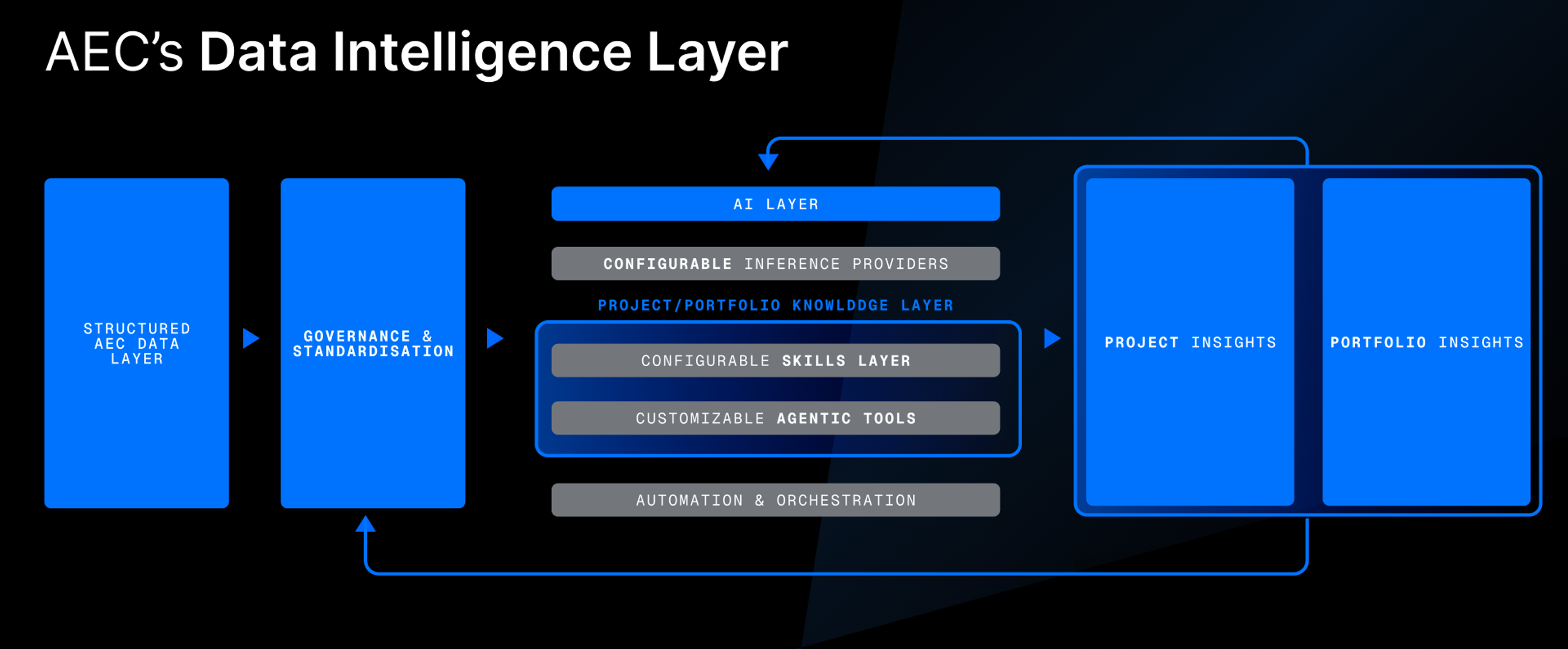
Almost every design authoring tool, CDE, and point solution in AEC now has an AI feature (if not, you should be wondering what their product team is doing!). There are chatbots bolted onto PDF-based workflow tools, copilots that turn partners’ voices into proposal-generating agents and MCP servers that promise to "connect your data" to any LLM you want.
In other words, access is no longer the hard problem, and we're back to facing the underlying issue the industry still hasn’t solved: how do we trust the data and answers surfaced to us by the newest wave of technology solutions?
Thus far, the industry has built most of our AI on top of documents (PDFs, exports, and drawings) that are already a step removed from the things they describe. In contrast, we built Speckle Intelligence on top of published model data. That distinction between querying the model and relying solely on downstream drawings and exports introduces a fundamental difference in how we apply AI to project workflows.
Here's what that looks like in practice:
1. You can trust the data, because you know its condition
Access to the published model isn't the same as trust in the model. Anyone who's spent time in real project data knows models are inconsistent — naming conventions drift, parameters go unfilled, elements get modeled by five different people five different ways.
Speckle validates data as part of the pipeline, so you're never just hoping the model is clean. You know its state. That matters because it changes how you read every answer Speckle Intelligence gives you: a report built on 98% validated data carries a different weight than one built on data nobody's checked. We're not asking you to have blind faith in the model or the AI — we're giving you the information to determine exactly how much confidence a given answer deserves.
2. Speckle Intelligence queries the source, not a snapshot of it, at any scale
Ask a question through Speckle Intelligence, and you're querying the latest published version of the live model, not an export someone made three revisions ago, which was already stale the day it was issued. That holds true whether the model is a single-floor fit-out or a multi-gigabyte infrastructure project. The processing harness we've built is engineered to handle the largest models in the industry without falling back to a simplified or partial read of the data.
That sounds like a small technical detail, but it isn't. Most "AI for AEC" tools are actually reading the exhaust of the design process — the documents it produces — rather than the process itself. By the time a drawing exists, decisions have already been made, and information has already been lost in translation. Querying at the source means the answer you get reflects the model as it actually is right now, not as it was described in whatever document happened to get exported last.
3. Speckle Intelligence actually understands AEC data, which makes it faster and cheaper
Speckle normalizes and understands relationships across every major design authoring tool — geometry, parameters, levels, rooms/spaces, systems/networks, hosting, materials, and MEP connectivity. This lets our users, human and machine alike, move beyond generic schema matching to real domain expertise in the specific shape AEC data takes, drawing on expertise built over years as the connective data layer across the industry's tools. And because Speckle is tool-agnostic, Speckle Intelligence can reason across adjacent Tekla, IFC, and Civil3D data simultaneously, something no tool-specific MCP can do.
That expertise pays off twice. First, it's why the AI can answer reliably rather than guess. Speckle Intelligence isn't reasoning from scratch about what a wall "probably" means; it already knows. Second, it's why it's cheaper to run. A general-purpose LLM pointed at raw model data through something like a Revit MCP has to work everything out from first principles on every single query. Speckle Intelligence skips that: the structuring work is already done, so the query it actually runs is smaller — and a smaller query costs less to run.
4. You can check its work
Underneath the hood, Speckle Intelligence is really just very good at writing structured queries against your validated data. SQL tool calls are inspectable; bound KPIs, charts, and tables expose the SQL, status, row counts, and duration, and report bindings are preflight-validated. That's the whole trust model, and it's a deliberate one: not "trust the AI," but actually check and inspect its work.
Every report, every bound KPI, chart and table Speckle Intelligence produces comes with the actual query behind it, so you can open it up and see exactly what ran and which models and data sources it pulled from. Not every answer works this way: a quick prose or metadata response doesn't have a single query to point to. But wherever Speckle Intelligence is drawing on your data at scale, that data trail is there to check. In an industry that's rightly cautious about handing over judgment calls to a black box, that's the difference between a slick demo and something teams will feel comfortable using on a project.
5. It can reason across many models at once, not just one
Most AI-on-model-data conversations assume a single project, a single model, a single query. Speckle Intelligence isn't limited that way; instead, it can process and reason across data from many models simultaneously. This means it can answer questions that no single-model tool can even ask: How do space ratios compare across all projects in this portfolio? Which teams are consistently under-modelling MEP coordination? Where does this firm's model data quality actually stand, project by project, this quarter?
That's portfolio intelligence alongside project intelligence. A tool that only reviews one model at a time can tell you about that model. Speckle Intelligence can tell you about cross-project patterns and trends.
6. You can codify your firm's process, not just the industry's
Every firm has conventions that don't live in any schema — naming standards, QA checks, the specific way you calculate area or embodied carbon. Speckle lets you build task-specific skills around exactly that. Skills carry reusable instructions, starters, files, and warehouse tables, invoked via /skill-name.
Upload your naming conventions once, for example, and it becomes a repeatable skill that can be reused on demand, so that you can apply the analysis or check across any project you’d like. The same pattern applies to workspace analytics reporting or firm-specific carbon and area calculations: encode it once, apply it everywhere. It's not generic AI you're adapting your process to. It's AI shaped around the process you already have.
The through-line across all six of these is the same: increased data access without trust isn't worth much. The industry has been flooded with AI tools that can technically reach your data. At Speckle, we believe the ones that measurably impact your team’s workflows will be the ones where you can see where an answer came from, know how much to trust it, and check it yourself before it goes into a deliverable. And that's what we've built Speckle Intelligence to be.
Trust isn't something you take our word for. Sign up for a Speckle workspace, upload a model, and ask Speckle Intelligence a question yourself. Then open up the query and check its work. Try Speckle Intelligence today→

Virginia Senf
Growth Lead