Jun 23, 2026
Data warehouse meets design data: Connecting the last missing piece of enterprise intelligence
Most firms can answer what a model contains. Far fewer can answer how today's design decisions might affect tomorrow's procurement spend.
For years, AEC has invested heavily in capturing project data. Models are richer with data than ever. Cost systems are more sophisticated. Enterprise data platforms are becoming standard across all large organizations globally. Yet most teams still struggle to answer what should be straightforward business questions, like:
Which design approaches consistently outperform others across our portfolio? When design changes, how quickly do those changes show up in budgets? Are our contingency assumptions grounded in historical performance, or are we carrying estimates forward project by project? If not, how do we make that happen?
The challenge is that the design and enterprise data live in different systems, follow different structures, and rarely come together in a way that's useful for decision-making. The result is that organizations collect enormous amounts of information but extract only a fraction of its potential value.
Speckle now connects to Databricks and Snowflake (beta), with Microsoft Fabric support in progress.
The two barriers to portfolio intelligence in AEC
When AEC firms try to answer business questions using project data, they typically encounter two separate challenges.
The first is fragmentation. Design data lives in design tools with different file formats and Common Data Environments; often disconnected, even on just that level. Cost records, procurement history, financial performance, carbon data, and operational information live elsewhere, often in data warehouses and enterprise systems. As a result, answering cross-functional questions usually requires manual exports, spreadsheet joins, custom reports, or support from data engineering teams.
The second barrier is semantic alignment. A wall in Revit knows it's a wall. It doesn't know its cost code, procurement category, asset classification, or how it should be compared against similar elements from previous projects. One project may classify an element as a concrete wall. Another may categorize it under structural framing. A third may map it to a regional cost standard. The geometry is comparable, but the business context of it is not.
All this to say, bringing data into one place solves the access problem, but that’s only half the challenge. It doesn't automatically solve the interpretation problem. To create meaningful portfolio intelligence, firms need both connected data and a consistent business context.
Manufacturing learned this lesson decades ago. Connecting PLM and ERP systems created a shared language between engineering and business systems. AEC is now facing a similar transition.
What changes when design and business data can work together
Once design data and business data are deeply connected through a common structure, entirely new types of analysis become possible.
Cost forecasting becomes more responsive
When design and cost data are connected, the financial impact of design decisions becomes visible much earlier. Instead of waiting for manual quantity takeoffs, spreadsheet updates, or estimate revisions, teams can see how design changes affect budgets as they happen. This shortens the feedback loop between design and cost, unlocking more informed decisions and making design optioneering significantly more effective.
Procurement planning improves
When material quantities are connected and normalized across a portfolio, firms gain visibility into future demand long before procurement begins. Instead of managing projects in isolation, they can identify total requirements across multiple projects, aggregate purchasing power, negotiate better supplier terms, and spot potential supply chain risks earlier. What was previously fragmented project data becomes a strategic procurement advantage.
Portfolio benchmarking becomes practical
Most firms have years of project data but struggle to use it consistently because every project is structured differently. When design, cost, and performance data are normalized across a portfolio, teams can start comparing projects. This makes it possible to identify which design approaches consistently outperform others, where cost overruns tend to occur, and which decisions deliver the best outcomes across multiple projects. The goal is not simply to understand one project better, but to learn systematically from every project delivered so far.
Capital planning becomes evidence-based
When historical design, procurement, cost, and delivery data are connected, planning future programs becomes less dependent on assumptions. Organizations can evaluate new projects against similar projects delivered in the past, understand where risks typically show up, and forecast most likely outcomes using actual portfolio performance.
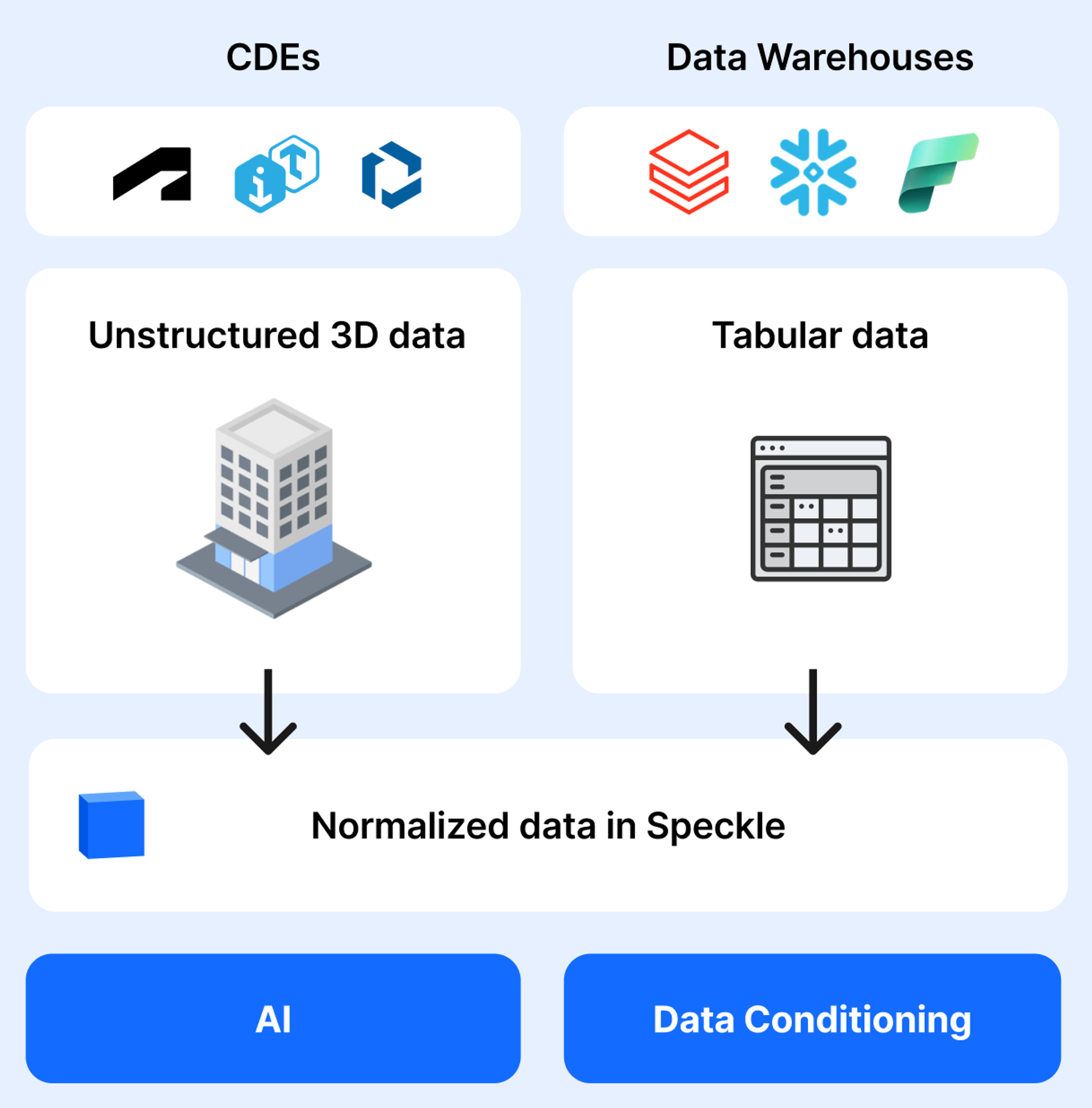
Normalized data in Speckle from CDEs and Data Warehouses
What the data warehouse is actually for in AEC
Databricks and Snowflake are among the most widely adopted enterprise data platforms for storing, organizing, and analyzing operational data at scale. For many large AEC organizations, it’s is where enterprise data already lives:
- Cost records
- Procurement data
- Financial performance
- Sustainability metrics
- Operational benchmarks
- Historical project information
It serves as the organization's analytical foundation and operational source of truth. It's also worth distinguishing between data warehouses and Common Data Environments, as the two are often confused. A Common Data Environment, such as Autodesk ACC or Bentley ProjectWise, manages design files, access control, workflows, and version history. A data warehouse exists for a different purpose. It enables analysis across structured data from many business systems. Both are essential, but they solve different problems. Speckle connects your design data with/from both of these data environments.
Speckle now connects to Databricks and Snowflake
For organizations that have invested in Databricks or Snowflake, questions about cost exposure, procurement risk, benchmarking, sustainability performance, or historical project comparisons often involve moving information between disconnected systems before analysis can even begin.
The new Databricks and Snowflake integrations (beta) close that gap. Speckle can now connect design data with the enterprise datasets organizations have already invested in building and maintaining within Databricks.
This enables teams to explore design and business data together through Speckle’s analytics dashboards and conversational AI, without requiring every project stakeholder to have direct access to the underlying warehouse.
A question like: "Which parts of this project align with cost categories that exceeded budget on our last three comparable projects?", no longer requires exporting model data, joining spreadsheets, or requesting a custom report because the systems are already connected.
What this creates is a governed link between the design environment and the enterprise data environment, allowing organizations to reason across both using the data they already possess.
What’s Next: Bi-directional data warehouse integration
In the near future, we want to make this connection bi-directional. That means design and construction data originating in Speckle will be able to flow directly into a team's data warehouse, unlocking automated pipelines, cross-system reporting, and the ability to combine Speckle's model intelligence with broader project, financial, and operational datasets.
For teams already running analytics infrastructure, this removes the last manual handoff between their design environment and their data stack.
Conclusion
The challenge for AEC is no longer collecting data. It's turning that data into decisions.
The firms that gain an advantage over the next decade won't be the ones with the most advanced models or the largest data warehouses. They'll be the ones that can connect design decisions to business outcomes, learn from every project they deliver, and apply that knowledge to the next one instead of starting from zero every time, or wasting time rebuilding pipelines.
The integration is available to enterprise customers running portfolio intelligence pilots.
Speckle now connects to Databricks and Snowflake (beta), with Microsoft Fabric support in progress.

Mirna Savić
Content Manager