May 6, 2026
Finally, models that work for you
Speckle’s latest release brings together major infrastructure updates across the web interface, validation, sharing, and data connectivity.
This set of interconnected capabilities is designed to give enterprise teams the control, clarity, and confidence to manage design data at scale, across every project in your portfolio. Together, these help teams move from finding data to seeing what needs attention.
For too long, staying on top of your project data has been a job in itself. Not designing, not delivering—just auditing. Hunting through models to find what changed. Manually checking whether the data is correct. Trying to piece together whether you're actually on track or whether something has quietly slipped.
This is reactive work. And in an industry where design decisions move daily, reactive isn't really good enough. The AEC industry has spent decades assuming that if you standardize the format and deliver the model, coordination follows. Thirty years have proved otherwise: data doesn't become useful when it's stored—it becomes useful when it's legible, when the right information reaches the right person, at the right time, in the right context. That's what Speckle is built to do, and we’re pleased to share that this release is the clearest expression of that yet.
At its core, this release is about helping teams answer a few simple but critical questions, without digging through models:
- Is this model current?
- Is the data complete?
- Is it getting better or worse?
- Who can access it?
That’s what makes data usable for real workflows and what makes it ready for analytics and AI.
An experience built around signals, not storage
The new Speckle web interface is designed around a simple shift: instead of going to your data to find out what's happening, it surfaces more project and model context up front. Key improvements include:
- Workspace, project, and model pages now present a wider range of information upfront, so you can spend less time navigating what’s changed and more time acting.
- A new workspace activity timeline gives you a live view of what's happening across your organization at a glance.
- There are now dedicated homes for issues and integrations, making it easier to find what changed.
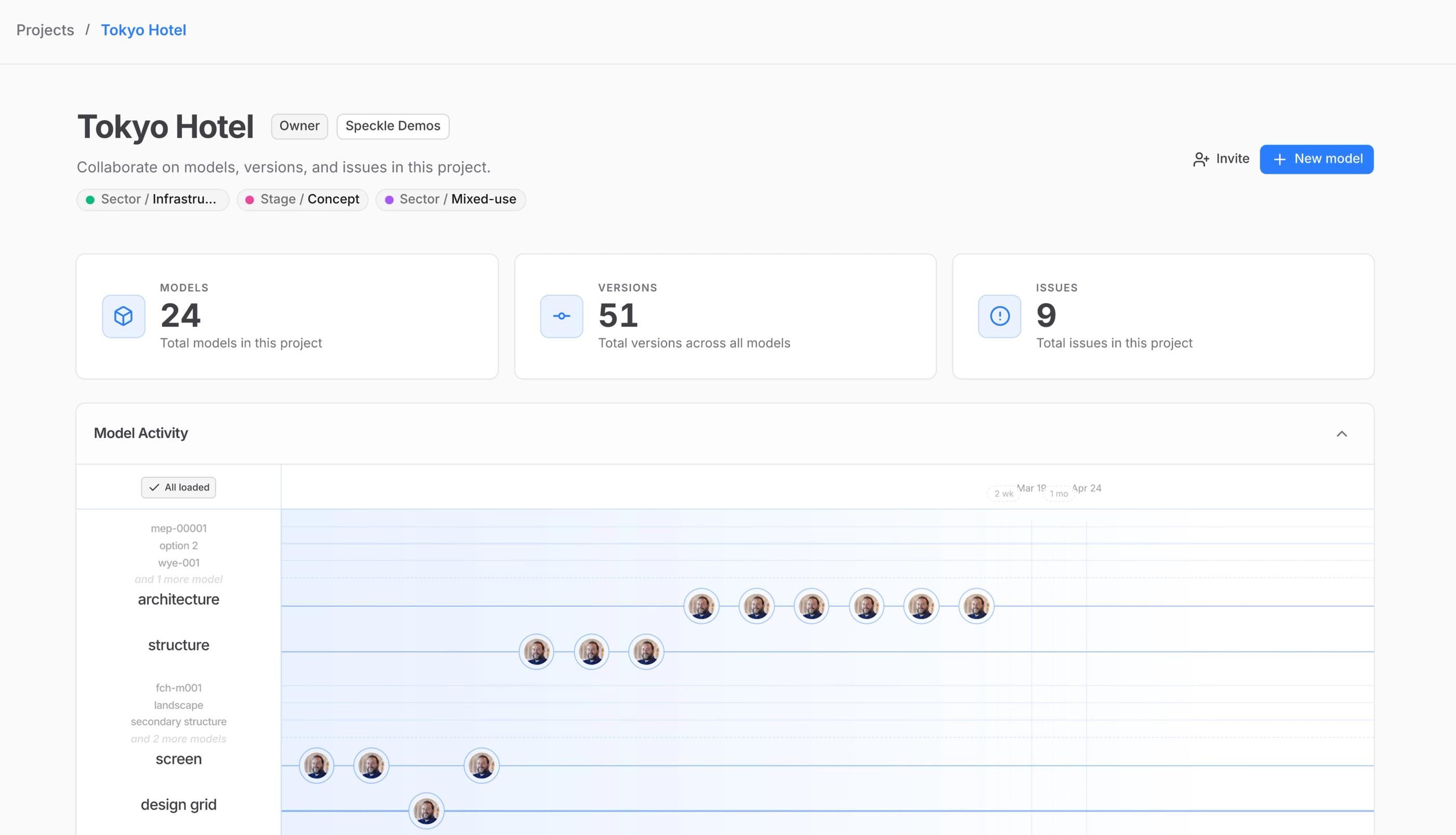
For teams managing complex portfolios across multiple disciplines, you can’t afford to lose time to your own data. With Speckle’s new user interface, you spend less time hunting and more time acting.
The Project Activity view is a great tool for workspace admins to see version data and active projects in the workspace.

Erling Nordli Husøy
Civil Engineer

Model Validation (beta): Measurable signals for model quality, the first step toward proactive intelligence
After months of working closely with several of our most visionary customers, our model validation capability is now in public beta. And for the first time, we’re excited to deliver a paradigm where your models tell you where to focus.
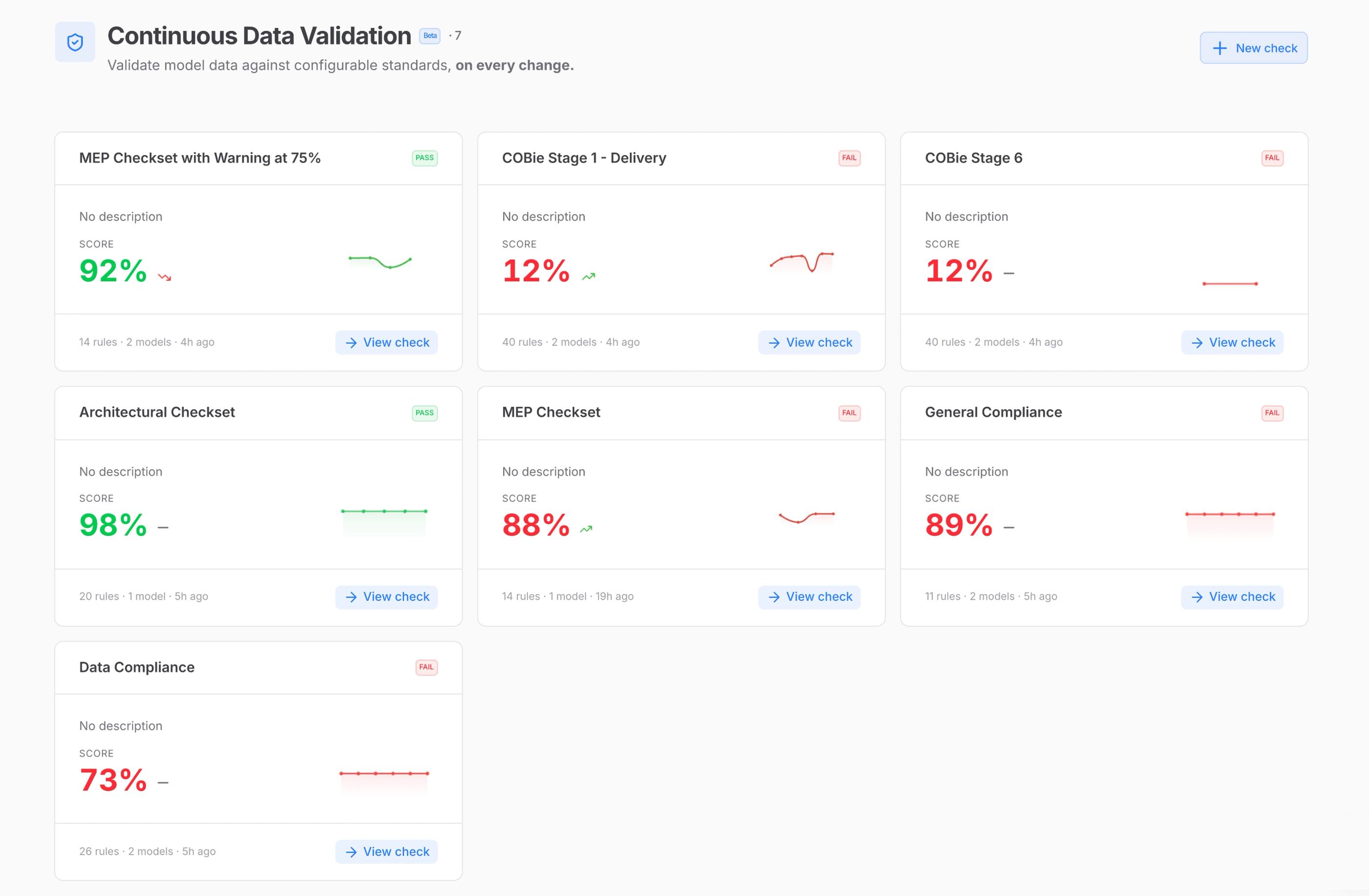
Validation highlights missing or inconsistent data against defined rules. By tying validation to model versions, teams can see whether data quality is improving or degrading over time. This is the first step toward understanding not just what changed, but whether those changes are good or bad.
For teams building toward AI-ready data, this is a foundational step. AI depends on being able to trust what it’s working with, knowing the data is current, complete, and consistent. AI doesn't fix bad inputs; in fact, it amplifies whatever is already there. Validated, normalized, connected model data is what makes any downstream intelligence actually trustworthy. Speckle’s Model Validation capability is how you build that foundation across your entire design data ecosystem.
Real-world project implications
Structural / coordination: A column grid shifts 200mm in the structural model. Speckle flags it before the architect has issued updated drawings, before the MEP team has clashed against the old position, before anyone on site has ordered the wrong spec.
Data quality / AI readiness: 300 elements in a model have no fire rating assigned. Speckle flags the gap at the model level, so the data is caught and corrected before it feeds into any downstream analysis, compliance check, or AI workflows.
Enterprise-grade access control
Two of the most common friction points for rolling out Speckle at scale have been user provisioning and external data sharing. Both are addressed in this release:
- SCIM support means Speckle now integrates directly with identity providers like Azure AD and Okta. Users can be automatically provisioned and deprovisioned from your Active Directory, eliminating manual permission management, error-prone admin overhead, and immediate revocation when someone leaves. Alongside this, a global token revocation API ensures that de-provisioning is instant and enforced.
- Advanced sharing permissions give teams granular control over what external parties can see. With Speckle, you can already share a link to a specific model or version rather than a whole project, so that anyone can open it on their phone or computer. Now, shareability is even more secure with password protection.
Across the interface, validation, integrations, and governance, this release gives teams clearer answers to those core questions, so they can act earlier, with more confidence in their data.
What's ahead: The path toward change intelligence
Right now, most teams find out something changed after the fact. They audit. They reconcile. They chase.
What we're building toward is the inverse: a model that tells you what changed, why it matters, and where you need to act, before the change ever becomes a change order or liability. This is a major shift that will flip our current paradigm—from the model as a static deliverable to the model as a continuously updated data source.
But there's a second dimension to this that matters just as much. Knowing what changed isn't only important to the people on your project team; it's equally important as input for the intelligence layer being built on top of your data. AI systems are far more effective on a continuous, structured record of what changed, when, why, and what it connects to. That's the semantic layer. Not a one-off export, but a living data foundation that's legible to humans and engines alike.
Speckle sits at the source, directly connected to the live design dataset and upstream of every deliverable, every drawing, every downstream artifact. The firms building on that foundation today aren't just improving their workflows. They're creating the conditions for AI to actually work on their behalf.
Model Validation (beta) is the first step in that direction. The data foundation you're building today is what makes that intelligence possible tomorrow. The firms that get there first won't be the ones who waited for the capability to arrive; they'll be the ones who had clean, connected, validated data when it did.
Model Validation public beta is available on all plans. Create a workspace today or contact our team for a demo to understand how it can supercharge your firm’s AI readiness.
Try Model Validation (beta) on all plans, including free.

Virginia Senf
Growth Lead