Dec 5, 2025
Speckle and data lakes: The new backbone of construction
For an industry that pours concrete and raises steel, construction runs on something very fragile: information. Yet for decades, that information has rarely driven meaningful success for building industry firms.
Which is why, when Suffolk Construction’s Murat Melek says, “The system is broken,” you listen.
Murat Melek and David Morgan, two people with job titles almost no one in construction had just 10 years ago; Director of Design AI and BIM Data Engineer, are at the front lines of a transformation powered by their data lake, automation, and one increasingly pivotal platform: Speckle (which was actually listed as a role requirement for David's position). Let's explore how their pipeline works and how Speckle plays a role in it.
Watch Murat and David's interview in the SpeckleCon 2025 backstage
The messy reality of AEC processes
Every contractor knows the story: architects model in one way, engineers in another, subcontractors add their own layers, and then the contractor receives it and has to somehow make sense of it. Easy.
Suffolk Construction's goal, Melek explains, is to get those designs, whatever form they are in, and feed them into their pipeline.
In practice, this process is, unfortunately, not straightforward. David Morgan says that today, “realistically, it's a lot of copy-paste.” The data required for estimating, scheduling, and planning come from the model, but not in clean or even reliably accessible forms. Enter, Speckle!
Suffolk's pipeline powered by Speckle
David Morgan puts it all in context and opens up on the data lake and pipeline Suffolk has set in place, and what's guiding their thinking:
We have our modeling tools and ACC, and we're doing all this authoring, but how do we extract and clean the data? We push it into Speckle, making it accessible upstream for construction. That's our data lake system that helps process data and maintain clean business logic.

David Morgan
BIM Data Engineer

Suffolk uses Speckle as the universal adapter that normalizes, aligns, and reroutes BIM data into its centralized data lake:
If you want to get a good estimate or follow change orders, you need to bring all the data together. So Speckle is key for getting that building information data—which is messy, complicated, dirty—and getting it into our data lake in a way we can use.

Murat Melek
Director, Design AI
Once it’s there, Suffolk can tag, categorize, reason over, and act on that information programmatically and at scale.
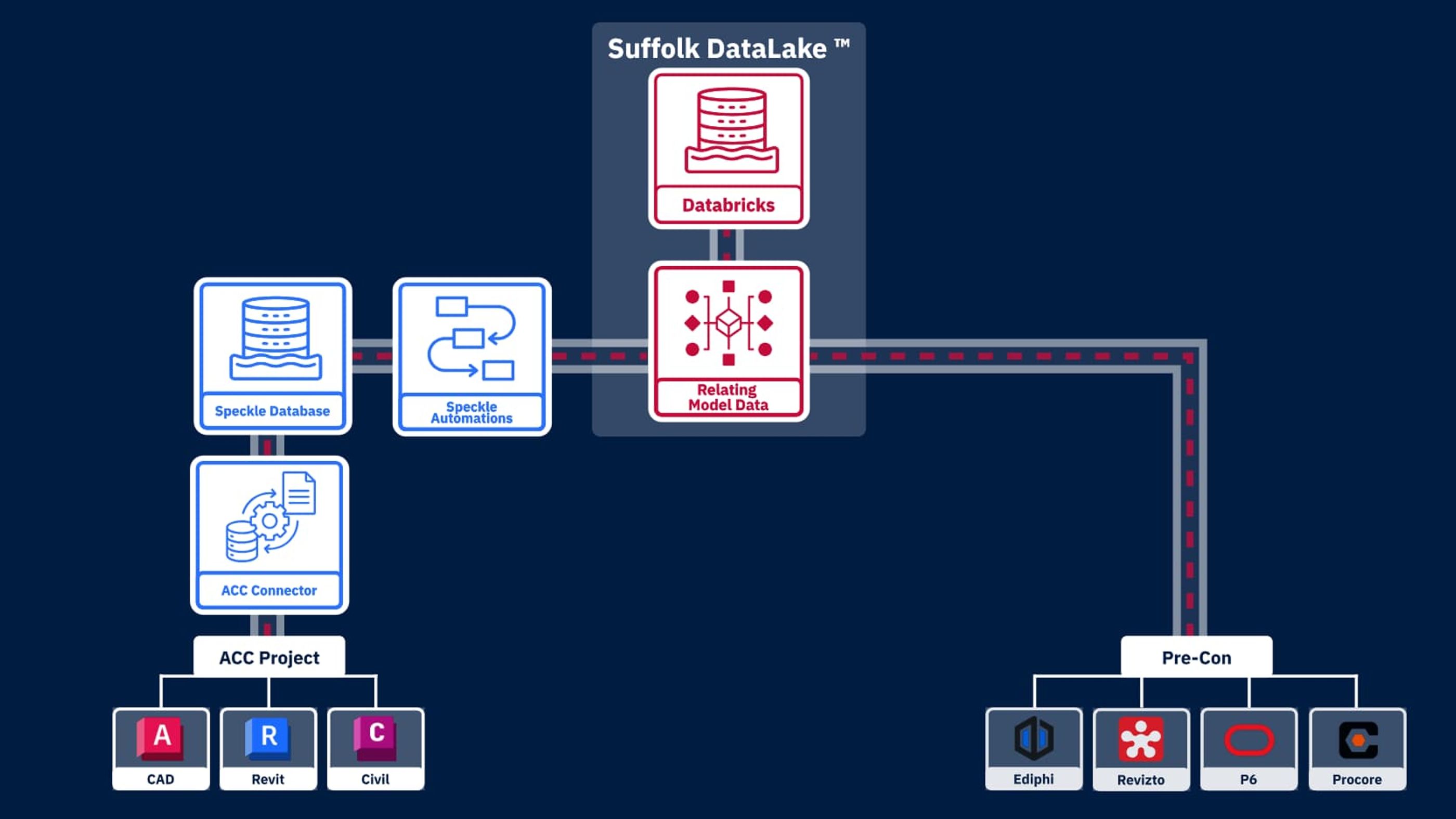
Suffolk Construction data lake pipeline with Speckle as the data layer
Getting data ready for AI and unlocking historical data value
Let's open this can of worms together: pricing in construction. It is entirely dependent on consistent data, which, as we keep pointing out, most projects don’t have. Melek gives a simple example of pricing a single room.
One wall modeled by Architect A. Another by Architect B. Different parameters, categories, materials, codings. Still, the estimator needs a single uniform cost code. To solve this, Suffolk built an automated pipeline:
We use Speckle Automate, and the AI algorithm is pretty much deciding, ‘Hey, based on what I see here, the closest matching code is xyz,’ so that we can programmatically move the data to estimation.
Murat Melek
Director, Design AI
With this pipeline, every project, every success, and importantly, every mistake becomes fuel for predictions. With Speckle providing access to this data across the board, historical project knowledge transforms into a real competitive advantage.
Suppose a specific wall element with a particular finishing detail keeps causing problems. How can we extract data from our BIM datasets and convert it into a format that AI can make sense of to identify those patterns? This lets firms like Suffolk notice design faults before they become a problem on site, and result in delays and extra costs.
Speckle as the fast track to data maturity in construction
One (un)surprising insight from Morgan: very few people at Suffolk Construction actually use Revit on a daily basis:
Not many people use Revit, but it depends on this type of design data. So that’s the big value for us: we have a small team that uses Speckle to distribute all this BIM data and actually get it into the hands of people who aren't necessarily working with it.
David Morgan
BIM Data Engineer
Speckle allows stakeholders who aren’t trained in design software to see and interact with BIM data anyway. Estimators, planners, PMs, and superintendents (roles that normally see only PDFs) suddenly gain access to structured, queryable model information. In an industry still tied to legacy workflows, Speckle acts as the data layer that powers internal data lakes and drives real data maturity across construction firms.
Final word
Construction doesn't need more software. It needs connected, accessible, usable data. Data lakes are becoming the nervous system of modern contractors, and Speckle is rapidly establishing itself as the gateway unlocking BIM data and finally enabling better decisions for the people who need access to it.
And for the first time (finally), contractors can look at their digital infrastructure and see business value. As Morgan put it: “Working with Speckle is a really key value-add for us to be able to build and achieve our goals faster and more efficiently.”
While much of the industry is still developing its data maturity, forward-thinking contractors like Suffolk aren't waiting. They're using Speckle now to reduce risk, improve decision-making, and deliver projects more efficiently. Data infrastructure is quickly becoming a competitive differentiator. That gap will only widen as organizations put their data lakes to work and enable AI-driven workflows that transform how buildings are designed, built, and operated.
Activate Speckle's ACC integration to automatically sync with every project change, unlocking historical model insights and real-time analytics.

Mirna Savić
Content Manager