Feb 27, 2026
The $177 billion data problem AEC can't afford to ignore: How better data infrastructure delivers faster projects and higher margins
Over the last fifteen years, the Common Data Environment has revolutionized how the AEC industry manages project information. For the first time, teams could collaborate on a shared platform, version control became manageable, and the chaos of emailed spreadsheets and conflicting file versions started to recede. It was a necessary step forward, bringing order to an industry drowning in documentation.
But today, the CDE is showing its age. Modern AEC projects generate more data than ever before. Buildings are more complex, project teams are more distributed, and stakeholders demand real-time insights into everything from carbon emissions to construction progress. Yet most firms are still managing this explosion of information with infrastructure designed for a simpler era, one built around files and folders rather than data and intelligence.
The industry that designs and builds the world's most sophisticated structures deserves data infrastructure that matches the complexity and ambition of what we create. It's time to move beyond the CDE paradigm.
The limitations we've learned to live with
The CDE served its purpose, but its fundamental architecture reveals limitations that become more glaring with each passing year.
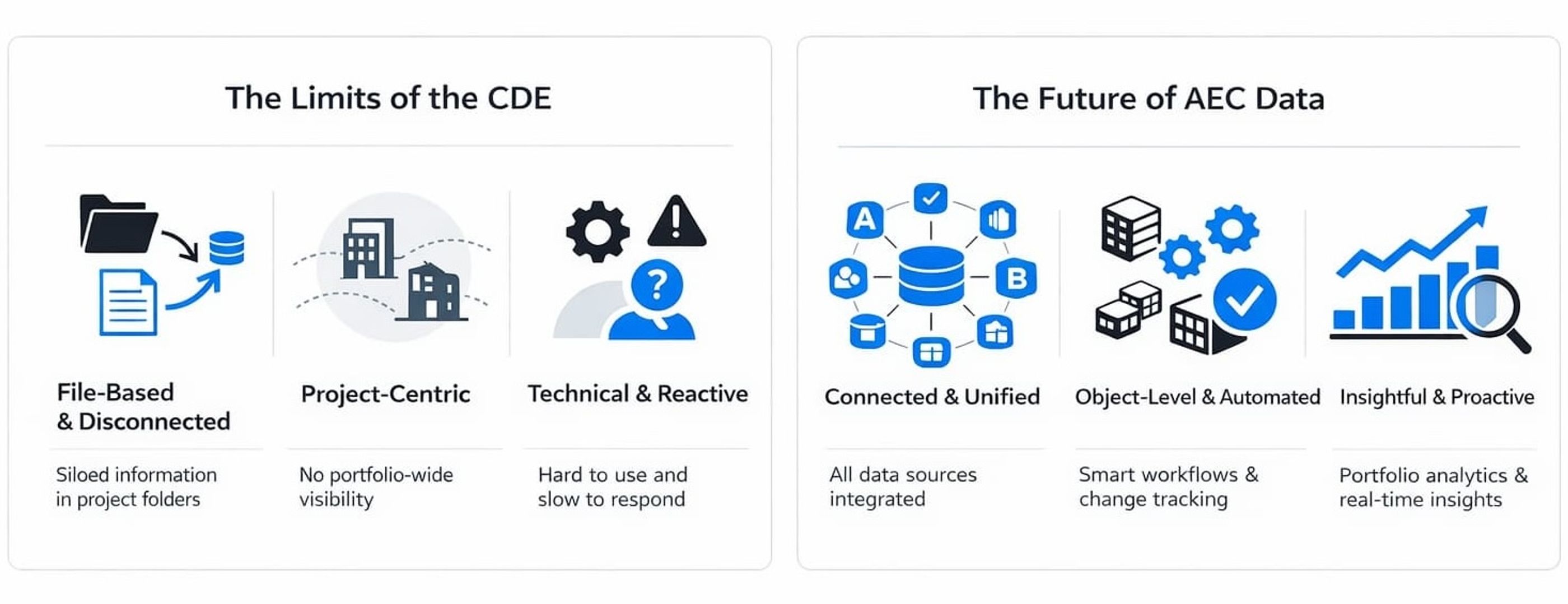
Built around files, not data
CDEs were designed as sophisticated file repositories; places to store, version, and share documents. But modern projects need more than just file management. When a structural engineer updates a beam specification in Revit, that change has ripple effects across cost estimates, carbon calculations, construction schedules, and facilities management plans. A file-based system can't automatically surface these connections to affected stakeholders or trigger the downstream updates needed.
According to a study by FMI Corporation, the construction industry loses $177.5 billion annually in labor costs due to inefficient activities such as searching for project data, resolving conflicts, and correcting mistakes. The same study found that poor data and miscommunication account for 48% of all rework, costing an additional $31.3 billion per year. Much of this waste stems from the inability to treat project information as connected data, rather than isolated files.
Siloed by project
Another major challenge of our existing infrastructure is that CDEs are inherently project-centric. Each project gets its own environment, its own folder structure, its own way of organizing information. This makes perfect sense for individual project delivery, but it makes portfolio-level insights nearly impossible.
How does your latest hospital project compare to the three you delivered last year? Which design decisions consistently lead to cost overruns? What sustainability strategies actually deliver on their carbon reduction promises? These questions require analyzing data across multiple projects, which is something CDEs simply weren't built to support.
The result? Firms keep making the same mistakes, missing the same opportunities, and failing to capitalize on the institutional knowledge locked away in past projects. McKinsey found that large construction projects typically take 20% longer to complete than scheduled and run up to 80% over budget. Better cross-project intelligence could help reverse these trends, but only if the data infrastructure supports it.
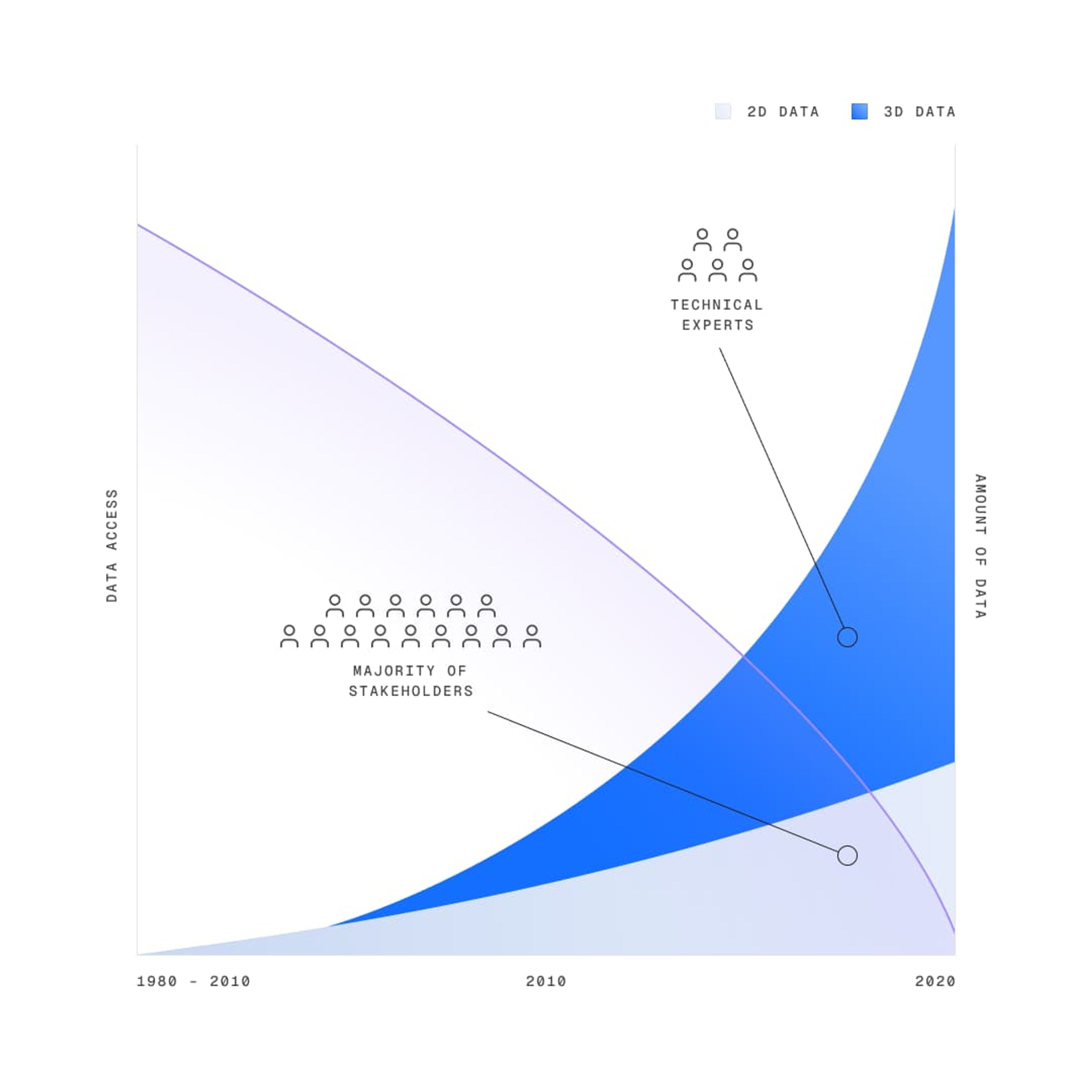
Designed for technical users only
Open a typical CDE, and you'll find an interface designed for project managers, BIM coordinators, and other technical specialists. Executives seeking portfolio insights, clients seeking project updates, or contractors tracking installation progress often find these systems opaque and difficult to navigate.
When only a handful of people on a project team can effectively access and interpret project data, decision-making slows down, coordination suffers, and the value of all that carefully structured information goes unrealized. The industry needs data infrastructure that's as accessible to a CFO analyzing project budgets as it is to a BIM manager coordinating clash detection.
Reactive rather than proactive
CDEs excel at storing information, but they're fundamentally passive systems. They don't alert you when design changes create cost implications. They don't flag when actual construction progress deviates from the schedule. They don't proactively surface the information you need to make better decisions; you have to know what you're looking for and where to find it.
In an era where other industries use data infrastructure that anticipates needs, surfaces insights automatically, and drives action through intelligent automation, the AEC industry is still manually hunting through folder structures, hoping to find the right version of the right file.
Why these limitations persist
Before we explore what comes next, it's worth understanding why the AEC industry has been slower than others to evolve its data infrastructure.
Regulatory reality and risk management
AEC operates in a heavily regulated environment, and for good reason. Buildings and infrastructure must meet strict safety standards, comply with building codes, and maintain detailed documentation for liability purposes. This regulatory reality has created necessary but onerous information management requirements that often prioritize defensibility over usability.
With the introduction of Digital Product Passport legislation in the EU and similar initiatives globally, these requirements are only becoming more stringent. Firms need systems that can track and verify product information, material specifications, and sustainability credentials throughout a building's entire lifecycle. The old CDE model struggles under this expanding burden.
Legacy vendor market power
Unlike industries like financial services or healthcare, where data platforms from companies like Snowflake, Databricks, and Microsoft have driven toward greater data accessibility and openness, the AEC technology landscape has been dominated by vendors with strong incentives to maintain data lock-in.
When a software company's business model depends on keeping users locked into their ecosystem, interoperability becomes a threat rather than a goal. The result has been decades of "walled gardens" where data flows easily within a single vendor's products (and sometimes not even that), but hits friction at every boundary.
As AI demands access to structured data, AEC firms are increasingly adopting these cross-industry data platforms. But there's a critical problem: the design data itself, with all its invaluable insights, remains trapped inside proprietary files, making it nearly impossible to unlock and connect to the operational data already living in enterprise data lakes.
Historical technology underinvestment
The construction industry has long underinvested in technology compared to other sectors. According to McKinsey, construction spends less than 1% of revenues on technology, compared to 3.3% in automotive and aerospace and 4.7% in advanced manufacturing. This underinvestment creates a vicious cycle: without modern infrastructure, firms can't realize the productivity gains that would justify further investment.
But this is starting to change. Forward-thinking firms are recognizing that better data infrastructure isn't an IT expense; it can actually drive competitive advantage and directly impact project outcomes, client satisfaction, and bottom-line profitability.
A new paradigm: Four tenets of modern AEC data infrastructure
What does data infrastructure purpose-built for AEC actually look like? Four core tenets define the path forward:
Tenet 1: Data source and vendor agnostic architecture
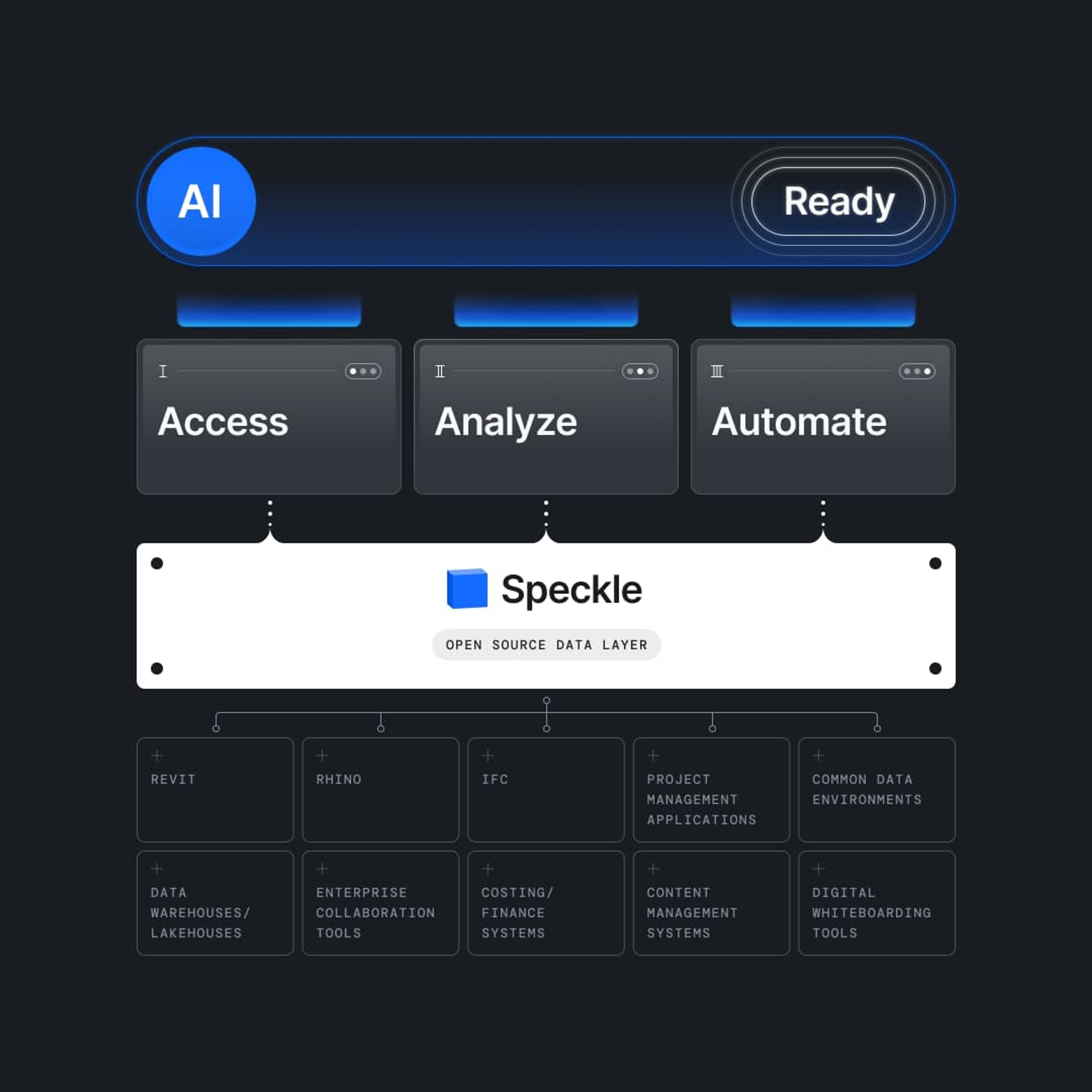
The future of AEC data management isn't picking the "right" platform and forcing everyone onto it. It's connecting all the platforms, tools, and systems that teams already use into a unified data layer.
This means unlocking data from native authoring tools, from Revit to Rhino to Microstation, and everything in between.
But it also means embracing the full ecosystem: cost estimating systems, construction schedules, IoT sensors, GIS platforms, and asset management databases. Real interoperability isn't just about viewing models from different software; it's about querying and analyzing across all data sources to answer questions that span traditional boundaries.
Consider what this enables: An architect's early-stage Rhino model can flow into cost estimating systems to generate real-time budget feedback. Structural changes in Revit can automatically trigger updates to fabrication schedules. As-built data from construction can feed directly into the owner's facility management systems without manual data re-entry.
Breaking down the walls between design, construction, and operations data isn't just a technical nice-to-have; it's essential to realizing measurably better project outcomes. Right now, the architect who designs a building and produces a carbon analysis has very little insight into whether that forecast actually stood up during construction and operations. A vendor-agnostic data infrastructure can close these feedback loops and drive continuous improvement.
Tenet 2: Object-level data with real change control
File-based systems track when documents change, but they can't tell you what changed or why it matters. Modern AEC data infrastructure must work at the object level, tracking individual building elements, their properties, and their relationships to other objects.
When you can track changes at this granular level, powerful capabilities emerge. Automated workflows can trigger actions based on specific changes: when a beam size increases, cost estimates update automatically; when a wall type changes, thermal performance calculations refresh; when a piece of equipment moves, clash detection reruns only for affected systems.
Most importantly, these automations can be reused and scaled across projects. Instead of recreating coordination workflows from scratch on every project, firms can build libraries of intelligent automations that embody institutional knowledge and best practices. The wheel was invented once, then deployed everywhere.
This is exactly what happened in software development. When version control systems like Git moved from tracking files to tracking individual lines of code, it unlocked entirely new ways of working: continuous integration, automated testing, and collaborative development at a massive scale. AEC is poised for a similar transformation.
Tenet 3: From projects to portfolios with multi-dimensional Views
Today, virtually all AEC tools are necessarily project-based. You open a project, work within its boundaries, and close it when you're done. This project-centric view serves individual delivery well, but prevents the cross-project analysis where true improvement happens.
Consider a large engineering consultancy that delivers dozens of similar projects annually, such as data centers, hospitals, and warehouses. Each project team solves similar problems: optimizing structural systems, coordinating MEP installations, and managing submittal workflows. But without portfolio-level data infrastructure, each team starts from scratch, unaware of solutions their colleagues developed on similar projects months earlier.
Unlocking the full potential of AEC data means enabling historical intelligence so that we can learn from past projects to inform future ones. Next-generation infrastructure must provide project-level depth when you need it while also surfacing portfolio-level patterns when you're looking for them.
This requires the ability to slice data across any dimension that matters: filter all hospital projects by structural system type, analyze all projects in a specific climate zone for energy performance, and track all projects with a particular contractor for schedule adherence. Dynamic views and templates must adapt to different roles and questions, as what an executive needs to see differs dramatically from what a coordination lead needs.
Manufacturing achieved this transformation years ago. Companies like Boeing and Toyota don't just track individual production runs; they analyze data across thousands of manufacturing operations to identify inefficiencies, optimize processes, and drive continuous improvement. AEC has the same opportunity if we adopt the infrastructure to support it.
Tenet 4: Visual, intuitive, and actionable for all stakeholders
Here's an uncomfortable truth: most project data never gets consumed. It's dutifully created, carefully organized, and promptly ignored because accessing and interpreting it requires technical expertise most stakeholders don't have.
Data that isn't consumed is just noise. Modern AEC data infrastructure must democratize access through visualization and intuitive interfaces that make information actionable for everyone who needs it.
3D visualization must evolve beyond pretty renderings to become an interface for live data. When a facilities manager clicks on an HVAC unit in a model, they should see real-time performance data, maintenance history, and predicted replacement dates, not just geometric properties. When an executive reviews a portfolio of projects, they should see interactive dashboards that surface progress, budget variance, and risk indicators - not static PDFs.
The financial services industry provides a compelling example. Twenty years ago, analyzing market data required specialized Bloomberg terminals and trained analysts. Today, platforms like Robinhood and Coinbase have democratized access to sophisticated financial data and analytics, enabling millions of people to make informed investment decisions. AEC needs a similar transformation, lowering the technical barrier so that if you can ask the question, you can get the answer.
Automated insights must replace manual reporting. Instead of BIM coordinators spending hours creating clash reports, systems should automatically identify, categorize, and prioritize coordination issues, then route them to responsible parties. Instead of project managers compiling weekly status updates from multiple sources, dashboards should surface real-time progress against milestones and automatically flag items requiring attention.
Why this matters now
The imperative for better data infrastructure isn't hypothetical; it's urgent, growing, and the stakes couldn't be higher. Meeting global climate commitments requires AEC to dramatically reduce embodied and operational carbon in buildings. But you can't optimize what you can't measure, and you can't measure what you can't access.
AEC projects have become dramatically more complex over the past decade: MEP systems, advanced envelopes, digital controls, and stringent sustainability requirements, all delivered by teams distributed across continents. The volume of data generated has exploded, yet teams are often left drowning in information while starved for insight.
Other industries faced the same trap and escaped it. Software moved from emailing code files to version control and continuous integration. Manufacturing shifted from managing CAD files to PLM systems that treat product data as a unified, queryable asset. Financial services built a real-time infrastructure that powers algorithmic trading and risk management.
AEC can make the same leap. The technology exists, the business case is clear, and a better data infrastructure that allows us to connect design intent with construction reality and operational performance is the foundation for all of it.
The competitive advantage of better data
The firms that embrace modern data infrastructure won't just work more efficiently; they'll fundamentally transform what's possible.
Speed and efficiency
When data flows automatically between systems, when changes propagate instantly to everyone who needs to know, and when coordination happens in real-time rather than through weekly meetings, projects move faster. Decision cycles compress from days to hours. Coordination issues get caught and resolved before they become expensive field problems. RFIs get answered faster because the relevant information is immediately accessible.
FMI Corporation's research on that $177.5 billion in annual waste due to poor interoperability points to the opportunity. Even capturing a fraction of that waste through better data infrastructure translates to a significant competitive advantage and improved profitability.
Quality and risk reduction
Better data infrastructure leads to better buildings. When design intent flows clearly through to construction and operations, less gets lost in translation. When automated validations catch errors before they reach the field, rework decreases. When past project data informs future decisions, teams stop repeating mistakes.
The same McKinsey research, which showed 20% schedule delays and 80% budget overruns, also found that the best-performing construction firms (those in the top quartile) delivered on time and on budget far more consistently. A key differentiator? Superior data management and technology adoption.
Innovation and new possibilities
Perhaps most importantly, when data becomes truly accessible, new possibilities emerge that weren't previously feasible. Generative design becomes practical when you can quickly evaluate thousands of design options against real project constraints. Predictive analytics becomes possible when you can analyze outcomes across dozens of similar past projects. AI and machine learning applications become viable when you can access the high-quality training data they require.
The organizations that can connect, collect, and activate the most data will win. Engineering service providers, general contractors, and owner-operators are particularly well-positioned here. Consider a large GC that can connect preconstruction BIM models with detailed records of what actually happened in the field—change orders, schedule impacts, quality issues, safety incidents. That firm can identify patterns: which design decisions consistently lead to constructability problems? Which trades routinely face coordination challenges? Which building systems generate the most warranty claims?
This historical intelligence transforms into future competitive advantage. Preconstruction teams can provide more accurate bids because they understand true costs and risks. Project teams can anticipate and avoid common pitfalls. Clients receive better outcomes because the firm is learning and improving with each project.
The path forward
It's tempting to frame what's emerging in AEC data infrastructure as the next generation of the CDE. That framing is misleading. Every CDE on the market today is fundamentally a document management system with collaboration features layered on top. What's actually being built now is something categorically different: data infrastructure that treats models, objects, and their relationships as first-class entities. That distinction matters because no amount of optimization on a file-centric paradigm will ever deliver portfolio intelligence, automation, or genuine feedback loops because those capabilities require a different foundation entirely.
The AEC industry has been underserved by its data infrastructure for too long. We've accepted limitations that other industries left behind years ago, not because we lack ambition but because the tools haven't existed to do better.
That's changing. A new generation of data infrastructure is here, one that is purpose-built for AEC, that embraces interoperability rather than lock-in, and that is designed for portfolio intelligence rather than just project delivery.
The question facing every firm is no longer whether better data infrastructure is possible, but whether they'll lead or follow in adopting it.
The leaders are already moving. Forward-thinking firms are piloting new approaches, building cross-project analytics, and demonstrating measurable improvements in project outcomes. They're realizing that in an industry with notoriously thin margins, even small efficiency gains from better data management translate to significant competitive advantage.
The followers will eventually come along as they are forced to catch up when clients start demanding the transparency, insights, and efficiency that modern data infrastructure enables. But by then, the leaders will have moved even further ahead, continuously improving through the feedback loops and institutional learning that only a comprehensive data infrastructure can support.
This transformation won't happen overnight, and the good news is that it doesn't require ripping out every system you use today. It starts with recognizing that better infrastructure is possible, then taking deliberate steps toward portfolio intelligence, universal connectivity, and democratized access.
The leaders aren't necessarily the biggest firms or the ones with the largest IT budgets. They're the ones asking better questions about their data and demanding infrastructure that can answer them.
Learn how leading AEC firms are adopting modern data infrastructure to drive better business outcomes.

Virginia Senf
Growth Lead