Jun 11, 2026
Butic The New School uses Speckle to connect BIM, automation, and applied AI
As part of the first edition of the AEC 4.0 Master’s Program at butic The New School, Speckle served as a connective layer among computational design, BIM authoring, data workflows, collaboration platforms, and applied AI systems.
This work forms part of the broader Speckle Academia initiative, a program that supports universities, schools, and training organizations in exploring connected workflows across BIM, computational design, automation, data analytics, and AI.
Rather than focusing only on individual software proficiency, the initiative encourages experimentation across interoperable systems and real-world project data flows.
Inside the AEC 4.0 Master’s program
Rather than presenting Speckle purely as an interoperability tool, the program positioned it as infrastructure for connected workflows across multiple platforms and disciplines.
Butic The New School is one of a growing number of educational organizations using Speckle to expose students to collaborative, cloud-based workflows spanning design, coordination, analytics, and automation.
The program was led by David Moreira, Speckle Ambassador and Director of Artificial Intelligence, BIM Programming and Data Science at butic The New School, who has been actively exploring how connected BIM data, automation, and AI workflows can be applied together in practical educational and project contexts.
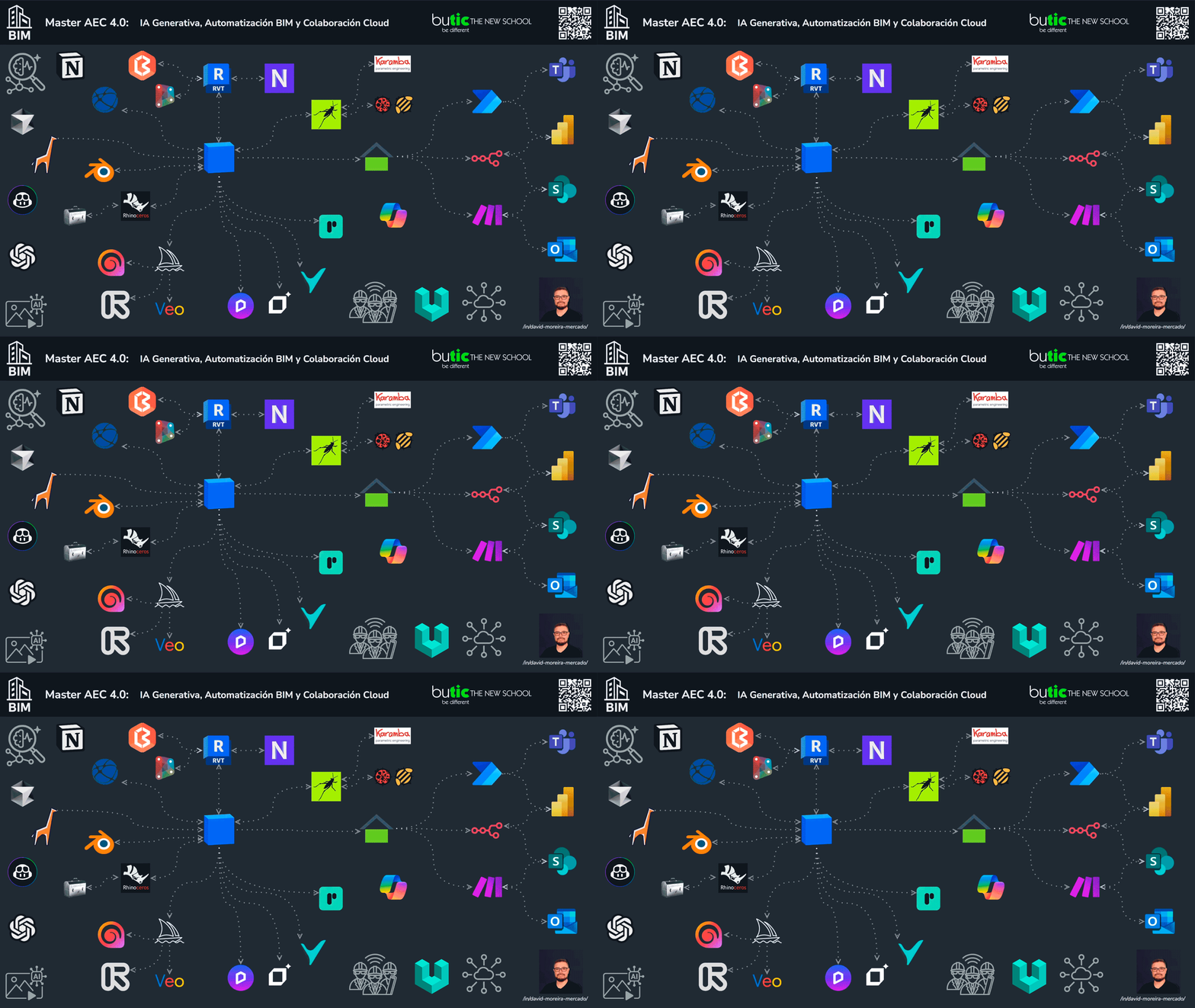
The course explored practical integrations between Rhino, Grasshopper, Revit, Dynamo, Dalux, Power BI, Microsoft Teams, Microsoft Copilot Studio, and Speckle’s web platform, with a strong emphasis on live data exchange, automation, and accessible collaboration.
Rhino, Grasshopper, and Revit workflows
Within the computational design module, students worked through live workflows that connected Rhino and Grasshopper directly to Revit via Speckle.
This included:
- Publishing geometry and metadata from Rhino/Grasshopper
- Assigning Revit categories upstream
- Receiving structured BIM content inside Revit
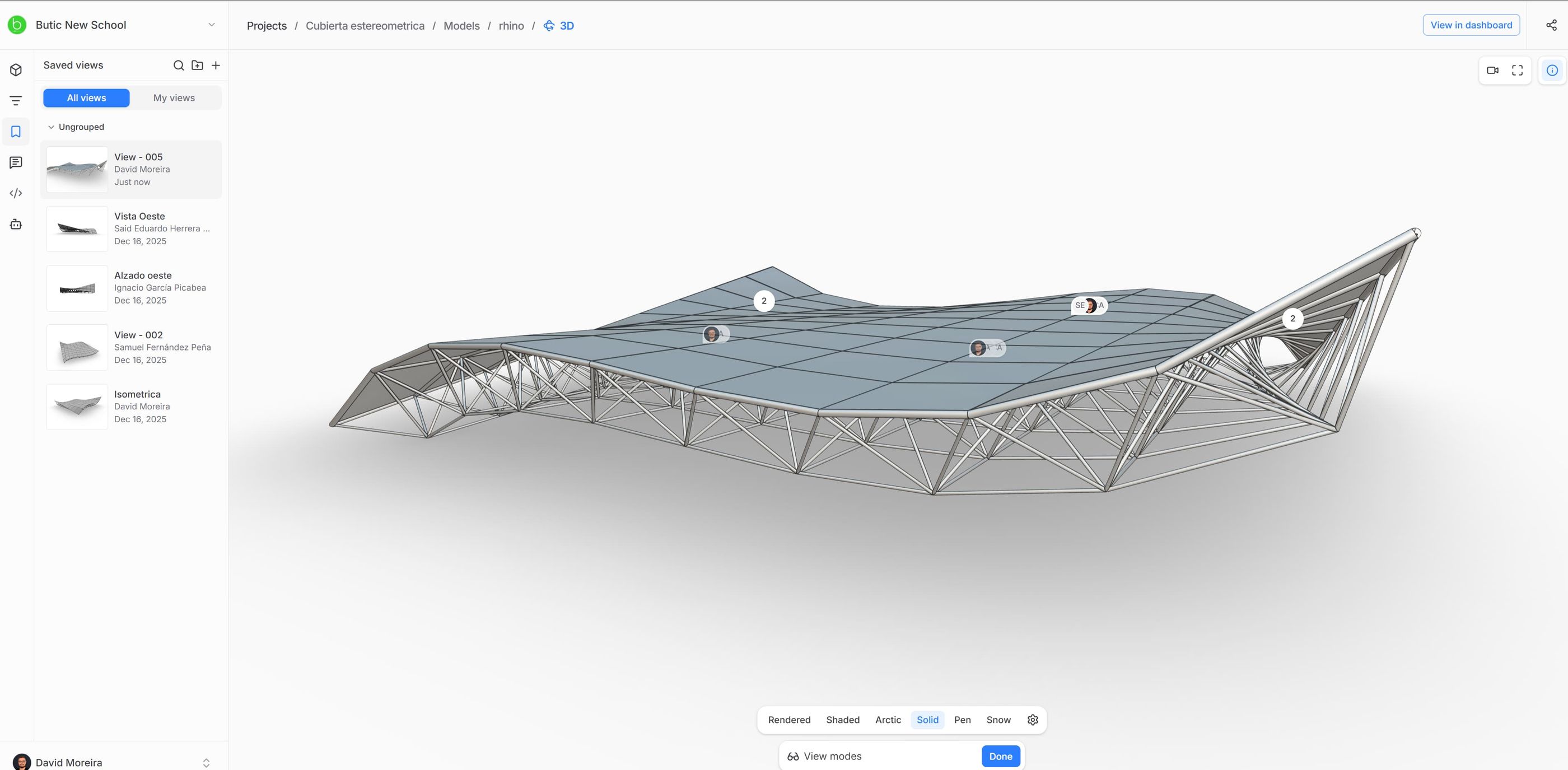
- Reviewing models through the Speckle web platform
- Using comments, saved views, mobile viewing, and Miro integration for coordination
Students then extended these workflows independently within their final projects.
Several explored hybrid pipelines, such as:
- Giraffe → IFC → Speckle → Revit → Dynamo
- Giraffe → Speckle → Rhino/Grasshopper → Speckle
These workflows were applied to parametric design studies, coordination exercises, and downstream BIM automation use cases.
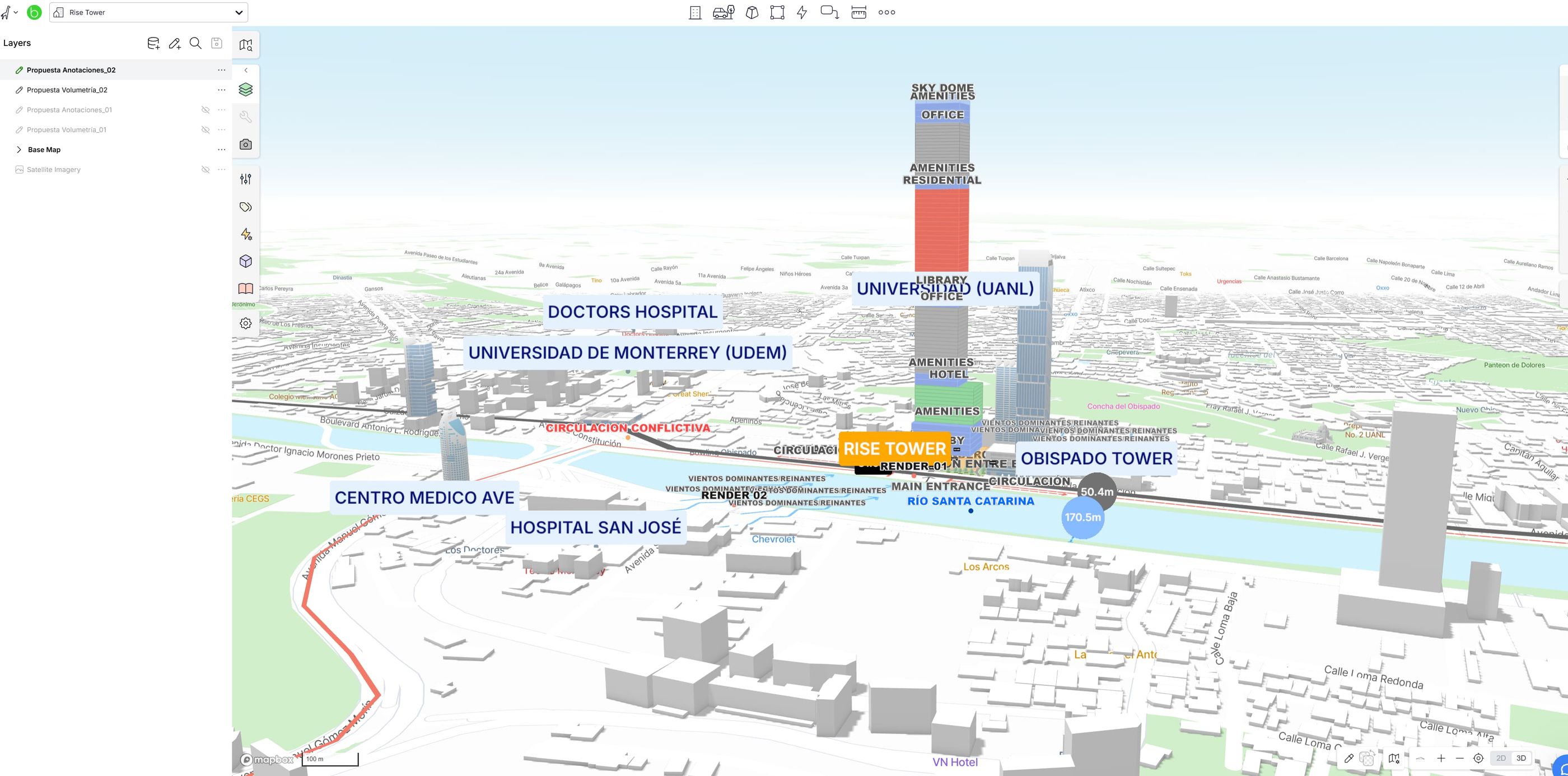
During one review session, students also identified and reported a scale issue in a Giraffe-to-Speckle workflow related to unit conversion; an example of real-world interoperability testing emerging directly from the educational process.
BIM data as connected data
Within the construction management and collaboration module, Speckle was introduced alongside Dalux and Power BI as part of a broader strategy for preparing connected BIM data.
The focus was not only on viewing models, but on:
- Extracting and standardizing model information
- Preparing BIM data for reporting and analytics
- Structuring information for downstream AI workflows
- Creating lower-friction paths between traditionally isolated platforms
Students explored how BIM information could be transferred between authoring environments, coordination systems, dashboards, and AI interfaces without relying solely on closed ecosystems or file-based exchange.
Speckle was presented as a practical environment for quickly prototyping and testing these connected workflows.
AI agents connected to BIM data through Teams
One of the most advanced workflows developed during the program connected Microsoft Teams directly to BIM model data stored in Speckle.
Using Microsoft Copilot Studio, Power Automate, and Speckle’s GraphQL API, the class developed a conversational agent that can query BIM data directly from Teams.
The workflow looked like this:
Teams → Copilot Studio → Power Automate → Speckle GraphQL API → BIM model → response back into Teams chat
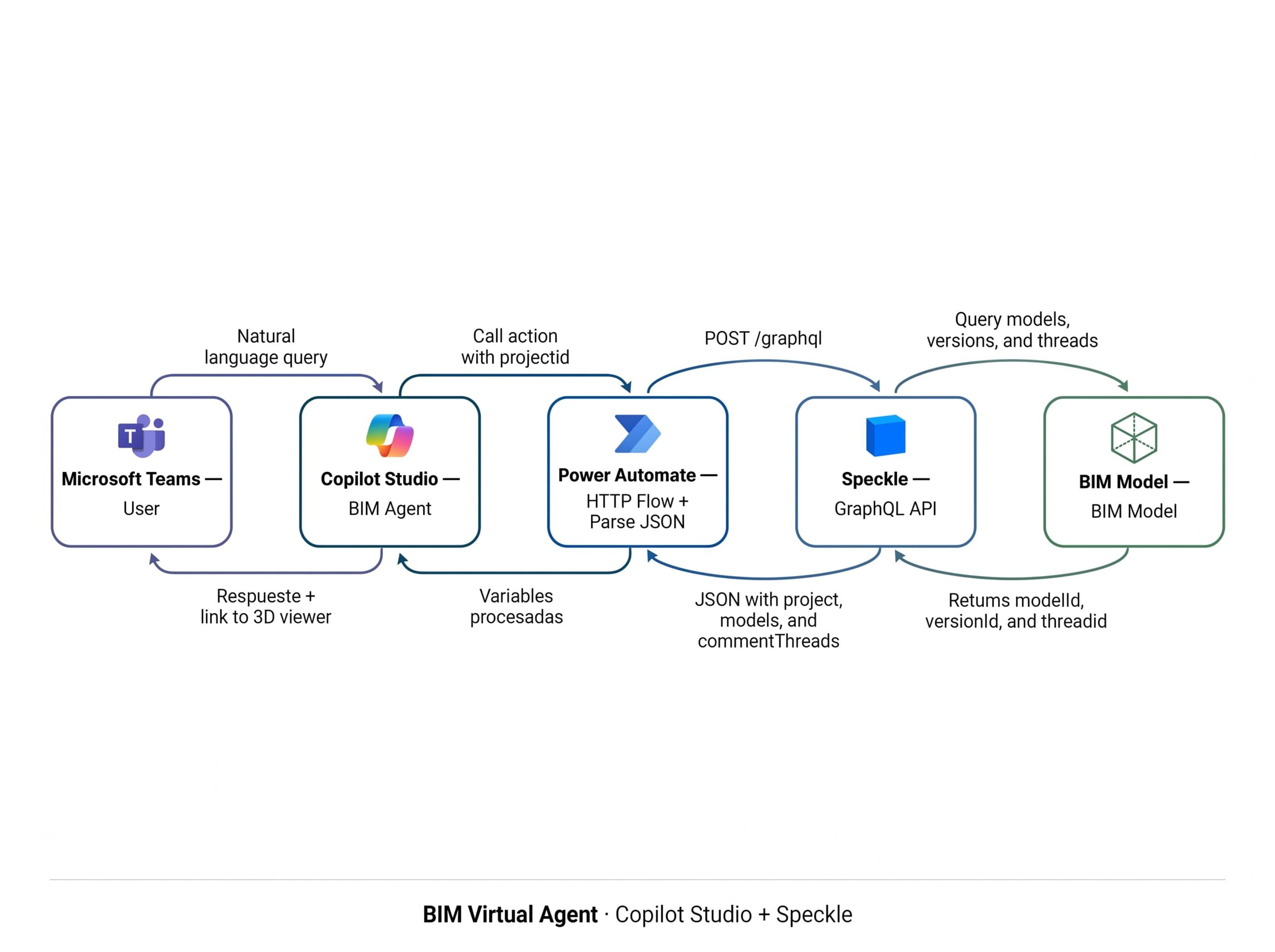
This allowed users to retrieve model properties, comments, and version information directly from the same communication environment where project discussions already take place.
Rather than AI existing separately from project data, the exercise demonstrated how AI agents can operate directly against live BIM information within existing collaboration environments.
Speckle as a transversal layer
Across the program, Speckle acted less like a standalone application and more like a transversal data layer connecting otherwise fragmented tools and workflows.
This included:
- Rhino ↔ Revit interoperability
- Grasshopper ↔ Dynamo workflows
- BIM ↔ Power BI reporting
- BIM ↔ Dalux coordination
- BIM ↔ AI agents through Microsoft Teams
The result was a learning environment focused not only on software proficiency, but on connected systems thinking across design, delivery, coordination, and analysis.
Continuing the collaboration
Following the success of the first edition of the program, butic The New School and Speckle are exploring continued collaboration for future editions of the AEC 4.0 Master’s Program.
The next edition begins in June 2026, with a further edition already planned for November.
As educational programs increasingly explore AI, automation, and cloud-native collaboration, examples like this demonstrate how connected BIM data can become a foundation for broader experimentation and applied workflows across the AEC industry.
Learn more about Speckle Academia. Speckle is free for students and educators.

Jonathon Broughton
Advocacy and Developer Relations