From Manual Markups to a Data Foundation that Scales: How WSP UK Future-Proofs Structural Delivery with Speckle
Company
WSP is one of the world's largest engineering and professional services firms. Within its UK business, the Structures team designs everything from individual buildings to major infrastructure projects, coordinating across Revit, Tekla, ETABS, and a growing ecosystem of internal tools along the way.
Today, Speckle sits underneath all of it as the connective layer that moves design data between authoring tools, powers cross-tool validation, and gives project teams a live view into their models without ever having to open the software that made them.
Here's how they’ve turned project data into a competitive advantage, and what it's unlocked for their business.
Challenge
The problem: every handoff was a chance to lose something
Before Speckle, moving data between design tools at WSP meant moving it by hand.
"It was all very manual processes," says Tom Sargent, a Senior Structural Engineer who helped bring Speckle into the business. "There were always friction points in the workstream.
Matt Lewis, who leads digital initiatives for the Structures team, agreed, “Every transfer was a series of manual checks, re-entries, and visual verifications, and every one of those steps was a chance for something to go wrong. We had to dedicate great effort to verify the data journey.”
The pain compounded whenever a design changed. An architect moves a column, MEP adjusts a duct run, and suddenly that change has to be traced by hand through reports, specifications, and BIM deliverables.
WSP had tried to solve this before. A bespoke Rhino and Grasshopper toolbar, built to act as a centralized data hub, showed promise in small pockets of the business, but never scaled. Large structural models overwhelmed it, and the learning curve was very steep. "There were small clusters of excellence," Matt says, "but it wasn't business-wide adoption."
Solution
Why Speckle, and not another integration
Matt and Tom had known about Speckle for years before WSP adopted it. What changed their minds wasn't a single feature, it was what Speckle made possible without asking anyone to become a data specialist first.
"If we looked at other solutions available on the market, doing this data piece felt like you needed to be a tech specialist," Matt says. "The immediate attraction to Speckle was how intuitive it was. Being able to connect our design data with our BIM delivery data, when we couldn't do that between an ETABS model and a Tekla model inside other data management systems, that was the big leap. It introduced a tool-agnostic approach that stood above anything we had seen in the market.”
That openness mattered just as much as usability. Because Speckle isn’t locked into a single vendor's ecosystem, WSP can pull Revit, ETABS, Tekla, and eventually its own internal tools into one shared environment, rather than being limited to whatever a single platform chose to expose.
The speed of iteration sealed it. During the trial period, Tom and Matt got used to seeing feedback turn into shipped features in weeks, not the "maybe it'll land in an update sometime next year" timeline the industry is used to.
"The amount of times I've rewritten internal documentation or slides because features have been added is quite impressive," Tom explains. "It's not something we're used to in this industry, the speed of update is wonderful."
Internally, getting to yes still meant clearing WSP's standard two-track approval process: financial sign-off proving return on investment, and technical sign-off confirming it was the right long-term bet. As Diego Padilla Philipps, WSP's Director of Decarbonisation and Innovation for Building Structures, puts it, that's rarely a purely financial conversation. "Half of what we do is convince people that some of the ROI isn't immediately obvious. It's about trust, and transformation, and some of that ROI isn't financial. It's just enjoying your job."
How they did it
What WSP actually built
Speckle now runs underneath WSP Structures as a shared data, governance, and intelligence layer, connecting design authoring, analysis, review, and reporting into one environment instead of several.
A few things stand out in how far that's gone:
- Validation moved out of individual desktops and into a shared workflow. Checks that used to require opening ETABS or Tekla directly - including span-to-depth ratios, model health and compliance rules - now run inside Speckle. Senior staff who moved into management years ago and no longer remember the software can still pull up the answer themselves. "It's no longer someone opening a modelling software package and spending twenty or thirty minutes trying to work it out," Tom says. "Now it's just, I click on Speckle, run the check, and see the pass rate."
- Parameter updates replaced PDF markups entirely. Engineers used to mark up fire ratings or reinforcement values on a PDF and hand them to a technician to key into Revit by hand. Now they enter the values directly in Speckle, and technicians accept the update. The unexpected result: teams started asking for richer Revit families, because for the first time, adding a parameter had a visible, useful payoff.
- A specialist tool became something anyone on a project can run. WSP's steel reuse analysis, originally a manual Excel exercise done by a specialist, now runs automatically through Speckle’s automation engine every time a model is pushed. It highlights reusable steel directly in the 3D model, and project teams can hand a client a screenshot showing the tool ran, not just a spreadsheet claiming it did.
- Decision-makers, not just engineers, became regular users. This was the biggest surprise for the team. Project leads and managers who previously had no meaningful way to engage with the design model now use Speckle's intelligence dashboards to track a project without being hands-on with the model. "They're already in Power BI for financial stuff," Tom says. "That migration to review dashboards has been really helpful, and a lot more impactful than we expected."
The moment that made the ROI real
When asked to put a number on the financial impact of a unified data layer, one example came up immediately: comparing steel tonnage between two versions of a model.
Before Speckle, that comparison meant pulling in three people. A Revit technician who exported a material schedule from one model version (a job that alone can take twenty minutes to an hour on a large model), exported it again from the previous version, and then handed both off to someone more senior to reconcile in Excel and present as a comparison.
"There's a Revit technician, the person asking for it, and someone doing the actual comparison for a senior designer," Matt explains. "So there's three people involved, and it can take an hour just to get the schedules out in raw form. Then there's probably another hour of someone in Excel figuring out what they're looking at, and how to present it."
All in, WSP estimates that added up to several hours of combined effort across three people, just to answer one question, and the answer was a plain list of numbers with no visual context.
With Speckle’s domain-specific dashboarding capability, one person runs the same comparison directly against the live model. It takes about twenty minutes, and the output is a visual report that surfaces the changes in the 3D viewer, rather than a spreadsheet of raw figures.
"Even if it's twenty minutes for someone to build that dashboard themselves," Matt says, "that's still someone who couldn't have gone into the model and pulled that answer out on their own. Now they can do it in Speckle without having to rely on anyone else."
Results
Putting numbers on it
WSP's original business case projected an efficiency gain of 20 to 40 hours per project from reduced rework and manual data handling that is now applied to higher value project work and improving project outcomes for clients.
What the team didn't fully anticipate going in was how much of the value would come from the intelligence layer rather than pure interoperability. Removing the barrier to accessing project data, so that anyone in the business can open a model and pull the information they need themselves, turned out to be much more significant than the time saved on manual data transfer.
Alongside the direct time savings, the team points to a set of benefits that don't show up on a spreadsheet but show up everywhere else:
- Fewer design errors and less rework, through automation and version control
- Real support for Building Safety Act and Golden Thread requirements, once projects reach that stage, from having all project data live in one governed environment
- A measurable drop in the repetitive, low-value work that used to eat into engineers' time and impact morale
- A platform that keeps pace with WSP's own roadmap, with the team actively shaping what gets built next
Future
Beyond any single project
WSP is now sitting on close to 4,000 structural model versions inside Speckle, with a clear line of sight to tens of thousands as adoption grows. That accumulated history is starting to change how the team thinks about design itself.
"We've got confidence that we can start to reuse that data to validate the rules of thumb we've used in early-stage design for years," Tom says. "Is a span-to-depth ratio really what we've assumed it was for a decade? How much does material typically grow across a project's lifetime? That's a nice metric we can actually look at now."
Matt sees the same shift in bigger terms. "This design data is no longer just a byproduct of the job. It's an asset. It's structured, it's governed, it's reusable, and it enables automation. "
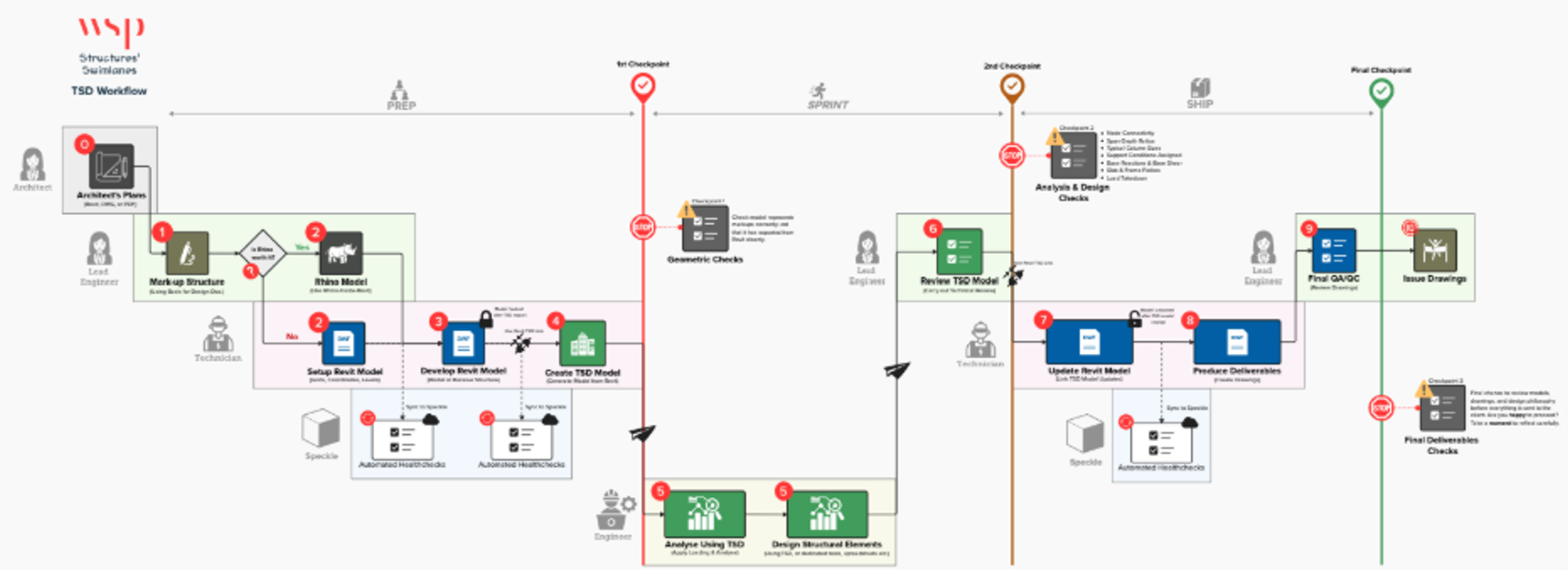
New large projects at WSP now start with a "digital surgery" session: mapping tools, workflows, and data ownership before any design work begins, specifically to identify where Speckle fits from day one. Disciplines beyond Structures, including MEP and Architecture, are starting to experiment with the platform as well. (See the sample workflow map below for reference)
Looking ahead, Diego frames the opportunity in terms of where the industry is heading. As authoring tools race to build AI features with a per-token cost attached, every software vendor will compete harder for time inside their own platform. Diego sees Speckle's role moving in the opposite direction; namely a shared data layer that reduces how much time WSP needs to spend inside any single tool, while keeping token burn in check through validated, structured data.The more vendors compete for WSP's time, the more Speckle's neutrality is worth.
WSP's UK Structures business uses Speckle as its data management, governance, and automation layer across Revit, Tekla, ETABS, and its own internal tooling. Curious what this could look like across your own portfolio? Talk to us.