gbi reduces reporting time by 20% and improves estimate accuracy using Speckle Intelligence
Company
gbi is a Quebec-based engineering consulting firm with over 475 employees and five offices across the province. With more than 60 years of experience, the company supports public and private clients across the full project lifecycle, delivering structural and MEP engineering services on complex projects that help shape the built environment in Quebec.
We spoke with Gabriel Sévigny, BIM Manager at gbi, whose team sits at the intersection of BIM, data, and innovation. They lead initiatives around AI and data standards, improve how the organization manages and scales engineering data, and evaluate emerging technologies—turning better data quality into measurable operational and business outcomes.
Challenge
Before partnering with Speckle, gbi faced a growing challenge many AEC firms recognize: data quality was limiting the value they could extract from their models. With poor data estimated to drive up to $1.8T in global losses through rework, delays, and bad decisions, the need to improve the reliability and accessibility of project data has become urgent.
In practice, gbi teams were exporting quantities and project data into Excel and PDFs—a slow, manual process that made it difficult to explore and trust the results. Gabriel estimated that 15–20% of his project time was spent managing data in this way, navigating spreadsheets, and exporting quantities.
He also explored building custom dashboards, but quickly realized that creating and maintaining a scalable reporting system would require a full development team, which wasn’t feasible.
The result was a clear bottleneck: valuable project data existed, but it was too time-consuming to standardize, validate, and turn into decision-ready insight.
Solution
gbi chose Speckle because it was the first solution that made model data usable and accessible across the engineering team, not just to power users.
Gabriel initially discovered Speckle through the Speckle for Power BI connector, but Power BI alone proved too complex for most engineers at the firm, was often slow to load, and was very difficult to scale beyond a small, tech-savvy group. Structural engineers don’t have time to onboard on a complex tool like this, says Gabriel.
Speckle Intelligence changed that. Instead of asking structural engineers to learn Power BI, Gabriel could share a ready-to-use visual dashboard that lets users explore quantities and insights directly within a 3D context.
We save time for technicians because they don’t have to produce Excel sheets and schedules anymore. And it improves the quality for clients, because we’re more confident in the numbers we share.

Gabriel Sévigny
BIM Manager

How they did it
Rolling Speckle out at gbi wasn’t just a tooling change; it became a catalyst for improving data standards at the source.
Gabriel’s team began by reorganizing model data in Revit to ensure that all data could be filtered and analyzed reliably in the dashboard. That meant cleaning up inconsistent families, fixing missing or misused parameters, and curating the model so Speckle Intelligence could surface the full value of the data.
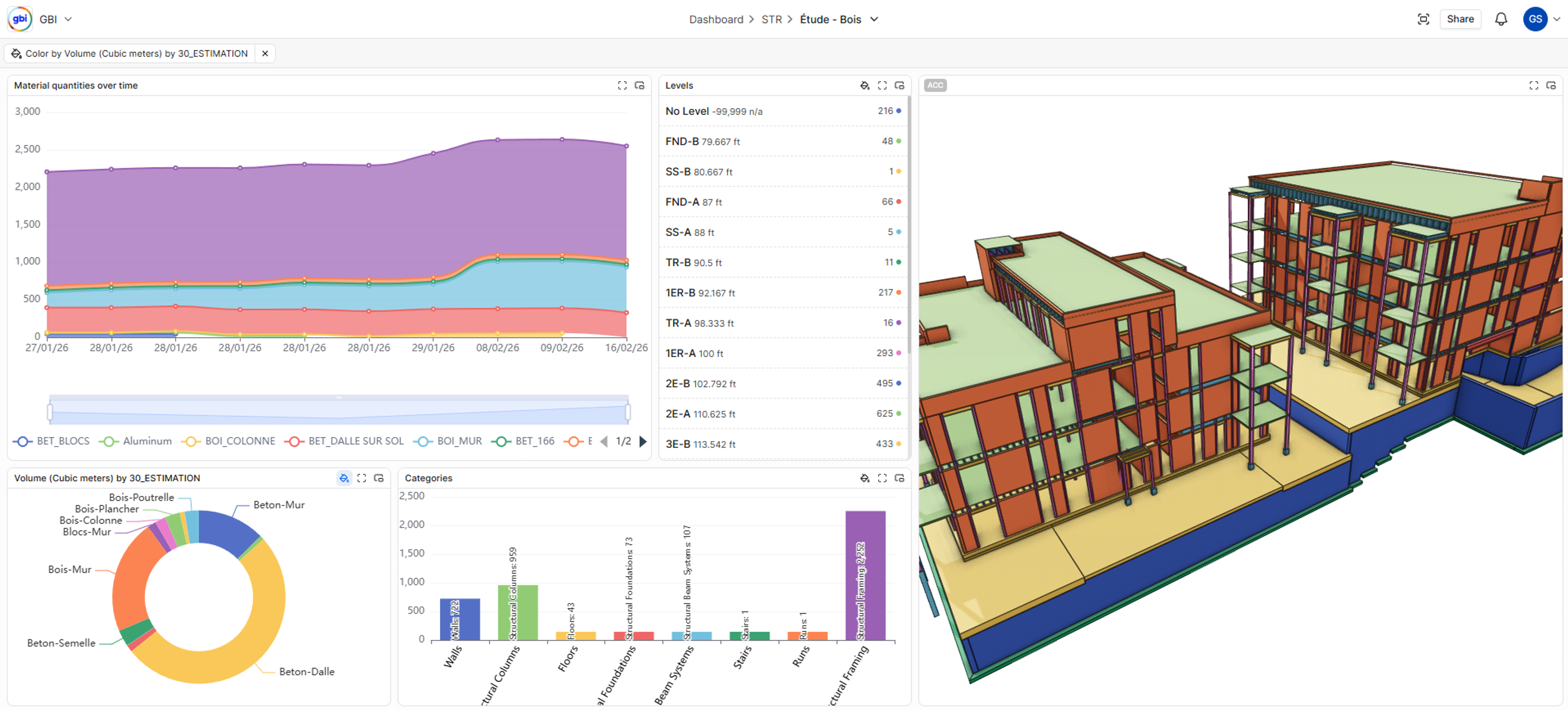
This work quickly exposed a deeper challenge: different authoring tools behave differently, and without a shared standard, parameters and object definitions don’t consistently match across projects. Speckle provided gbi with a clear rationale—and a practical mechanism—to rework their templates and advance toward a company-wide data standard.
The core challenge we solved after adopting Speckle was data ownership. To make Speckle’s ACC integration truly effective, we migrated our projects from external hubs to our own internal environment. We now use the ACC Bridge tool to push and pull models directly for external coordination.
Gabriel Sévigny
BIM Manager
Day-to-day, the team works directly in Revit, so keeping dashboards up to date with the latest model state was crucial. That’s where automated publishing came into play. With Speckle’s Autodesk Construction Cloud integration, Revit model data can be updated continuously, eliminating the need for manual exports and ensuring dashboards remain in sync as projects evolve.
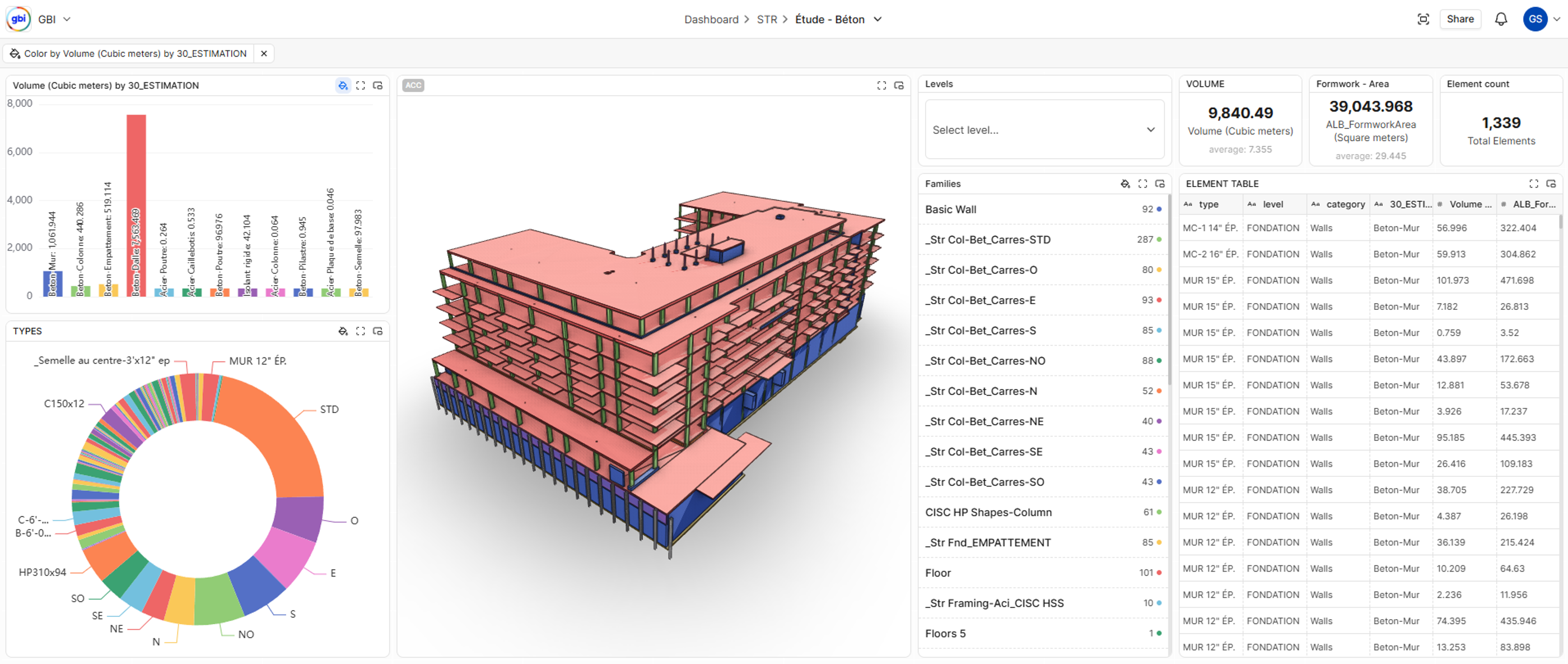
In practice, this changed both internal workflows and client delivery. Technicians no longer had to manually prepare reports, and teams could produce more reliable quantity takeoffs and estimates, particularly at key milestones such as the 30% project-completion stage, when teams are expected to produce early quantity takeoffs and provide clients with a more confident first cost estimate.
Speckle Intelligence reduces mistakes in estimation and makes our results more precise. For example, a beam might be modeled on the wrong level. Previously, we only had an Excel sheet indicating that ‘Level two has beams with errors,’ and we had to dig through the model to figure out what was wrong. Now, we can click on ‘level two’ and immediately see these problematic elements in 3D, and fix them.
Gabriel Sévigny
BIM Manager
Speckle also became a more effective means of communicating design. Instead of screen-sharing Revit in meetings, teams could use Speckle’s presentation features in the viewer to guide stakeholders through the model, making reviews more accessible, more structured, and far easier to follow.
Results
15–20% less time spent on manual data work
By replacing spreadsheet-heavy workflows, gbi reduced time spent on exporting quantities, building schedules, and managing project data, freeing up 15–20% of project time for higher-value engineering work.
Fewer errors in quantities and estimation
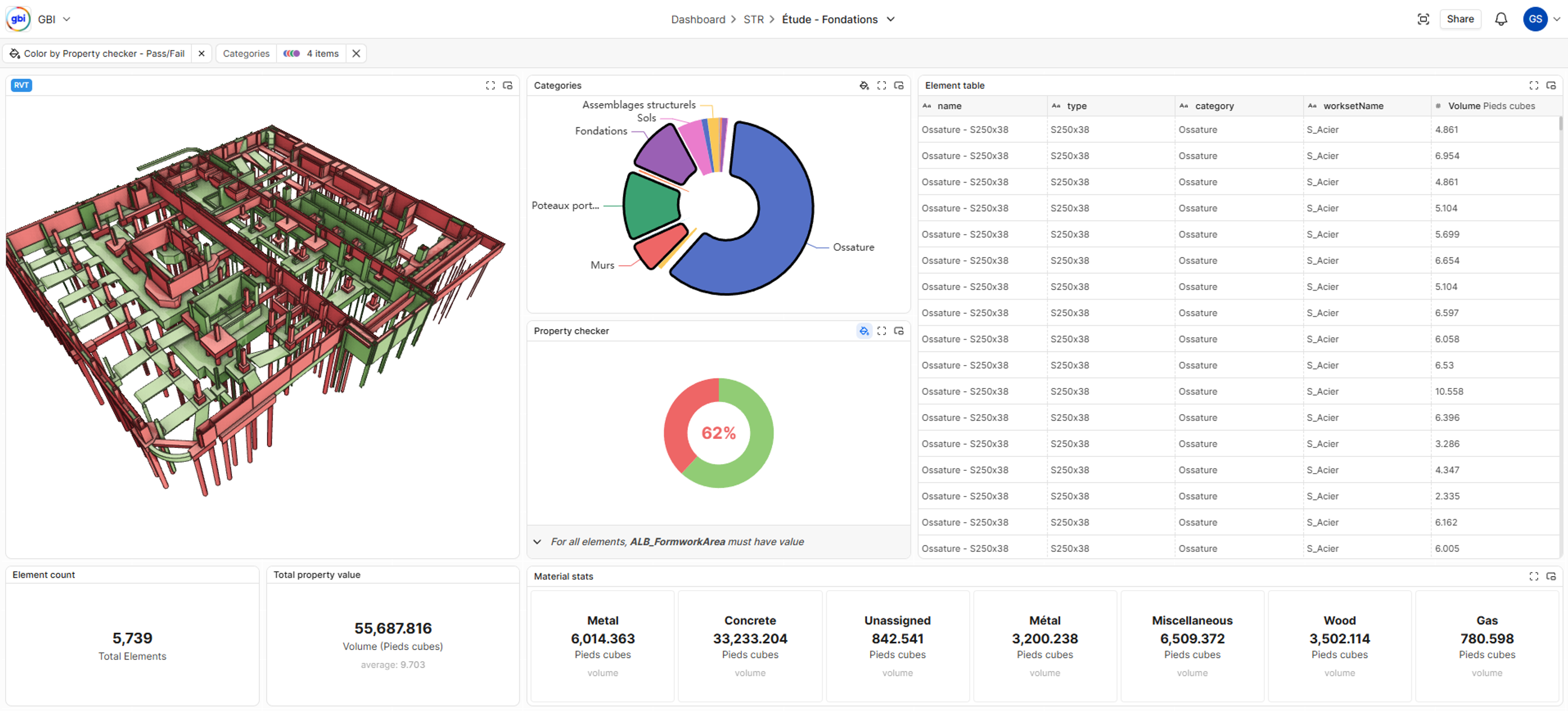
With dashboards connected directly to model objects, teams can spot mistakes that were previously easy to miss in spreadsheets—reducing the risk of incorrect quantities and improving confidence in early-stage estimates.
Faster validation in a 3D context
Instead of navigating Excel tables, teams can click into a metric and immediately see the corresponding elements in the viewer. This made exploration and validation dramatically faster.
Adoption across the team, not just power users
Speckle Intelligence proved significantly easier to learn than traditional BI tools. Gabriel noted that most team members could become productive in around 30 minutes, compared with an average of 3 days to onboard to Power BI effectively.
Future
Looking ahead, gbi is exploring the ETABS connector and sees strong potential in bringing structural analysis data into the same Speckle Intelligence experience.
The goal is to use a single dashboard across both Revit and ETABS models, combining multiple data sources in one place and extending project insight beyond BIM into engineering analysis.